When Amazon Shipping beats UPS or FedEx on cost
Amazon Shipping can win on lightweight residential ground volume, especially where surcharge waivers matter most. The right comparison is your invoices, not published rates.

When does Amazon Shipping beat UPS or FedEx on cost?
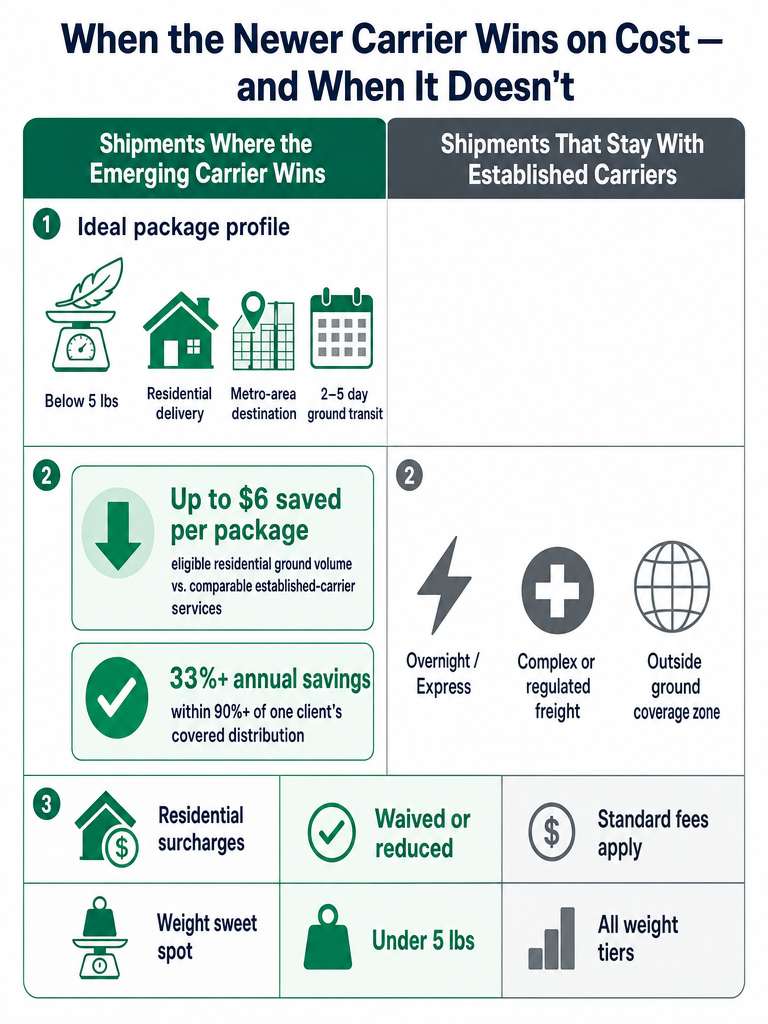
Amazon Shipping tends to win on lightweight residential ground volume, where fewer surcharges and simpler pricing add up. The gains come mostly from waived fees and eligible parcels moving on ground service, not from an across-the-board rate edge. Retail Dive reports that logistics data platform Loop is seeing clients save up to $6 per package by moving eligible residential volume to Amazon Shipping versus comparable FedEx and UPS services.
That $6 figure is directional, not universal. Matt Sumowski, who works in strategic solutions at Loop, cited a single large retail client on FedEx as his example. Read those numbers as one lane mix under one contract, not as a promise for your invoices.
Amazon Shipping is Amazon's parcel delivery service, now open to all businesses, that carries eligible packages on ground service and competes directly with FedEx and UPS on price. Sumowski told Supply Chain Dive the playbook has "often involved enticing shippers with surcharge waivers and less complex pricing versus FedEx and UPS."
So the honest answer: Amazon Shipping beats the national carriers when your volume is the kind it prices aggressively for. Miss that profile and the savings shrink fast.
Is Amazon Shipping cheaper than UPS or FedEx after surcharges?
Amazon Shipping is often cheaper after surcharges when your FedEx or UPS spend carries heavy residential and weekend fees, because Amazon waives both. That's where the gap opens. An Amazon spokesperson told Supply Chain Dive that transparent pricing, plus no residential surcharges or weekend delivery fees, has driven savings for shippers.
Base-rate savings and total-invoice savings are two different things. Sifted attributes to Amazon Shipping VP Ripley MacDonald the claim that most customers pay 30% less than base rates with FedEx or UPS. Treat that carefully. "Less than base rates" is a marketing frame, not a like-for-like comparison against your negotiated contract or your actual delivered cost after every accessorial.
The framing matters. If most of your FedEx or UPS spend comes from residential deliveries and weekend fees, waiving those two lines can move your total invoice more than any headline rate cut. If your surcharge exposure is low, the "30% less" pitch may not translate to your bill.
What matters is the number on your invoice after surcharges, and that depends on your own fee mix rather than any rate card. FedEx and UPS layer on residential fees, delivery-area surcharges, and weekend charges that shift by ZIP and by contract. Amazon Shipping's simpler fee structure is the lever. Isolate your surcharge total first, then compare.
What packages is Amazon Shipping best suited for?
Amazon Shipping fits high-volume retailers shipping lightweight, residential, ground-eligible parcels the best. Reveel's Jack McCrum said the service in 2024 and 2025 was focused on winning business from shippers with packages below five pounds. Retail Dive says Amazon Shipping currently offers two-to-five-day ground shipping in the contiguous U.S.
The service profile, in plain terms, from Sifted and Retail Dive:
| Attribute | Amazon Shipping |
|---|---|
| Max weight | Up to 50 lbs |
| Delivery speed | Two to five days, including weekends |
| Coverage | Contiguous U.S. |
| Pickup | From your warehouse, 7 days a week |
| Express option | None |
| Sweet-spot weight | Below 5 pounds |
| Residential surcharge | None |
The pattern is clear. If you move a high volume of small, residential parcels on ground timelines to metro-heavy destinations, your shipment mix lines up with what Amazon Shipping prices to win. Sifted notes the service delivers to the contiguous U.S. by working with USPS to fully cover all delivery destinations.
The heavier and more specialized your parcels get, the weaker the fit. That's the line where FedEx and UPS reenter the conversation.
Amazon Shipping vs FedEx, UPS, and USPS: where the cost comparison is fair
A fair comparison only holds when the shipment fits Amazon Shipping's service box: ground-eligible, contiguous U.S., under 50 lbs, no express requirement. Compare inside those limits and the numbers mean something. Compare outside them and you're pricing services Amazon Shipping doesn't offer.
Against USPS, the edge shows up at the lightest end. Hannah Testani, CEO of freight audit and payment company Intelligent Audit, told Supply Chain Dive that Amazon Shipping is even "undercutting" USPS on rates for packages weighing less than a pound — a slice of the market USPS has long held a pricing edge over.
But that's one expert's read, and shipper experience varies. On a fulfillment forum, one seller reported that negotiated UPS SurePost rates beat Amazon's offers 60–70% of the time for sub-pound packages. Sub-pound pricing runs close enough that your own negotiated contract decides which carrier wins.
Where the comparison is fair:
- Lightweight residential parcels, ground service, metro-heavy destinations
- Sub-pound packages, where Amazon Shipping and USPS run close
- Contiguous U.S. lanes inside Amazon Shipping's coverage footprint
Where it isn't fair: express, oversized freight, international, or hazardous shipments. Public rate-card comparisons for the same parcel, zone, and service across all three carriers aren't available in the sources here, so run your own invoice numbers rather than trusting a matched example you didn't build.
What are the tradeoffs of using Amazon Shipping instead of FedEx or UPS?
The tradeoffs are service breadth and coverage, and either one can erase the per-package savings. Amazon Shipping is ground-only with no express option, so anything time-critical still needs FedEx or UPS. Retail Dive says Amazon Shipping currently offers two-to-five-day ground shipping in the contiguous U.S., which means overnight and next-day simply aren't on the menu.
Coverage is the second constraint. Sifted says pickups were available in only 15 metro markets at the time of publication, making pickup coverage a short-term limitation. Amazon Shipping Director Michael Cox told Sifted the plan is to expand — "anywhere Amazon has a facility, we want to be there, so it's just a matter of when" — but "when" isn't a lane you can ship on today.
The narrower focus compounds it. Retail Dive's expert sources described a 2024–2025 emphasis on packages below five pounds and metro-area destinations. Heavier parcels and rural lanes fall outside the sweet spot. When your volume skews toward express, rural, oversized, or complex shipments, FedEx or UPS often remain the better cost-adjusted fit even at higher base rates.
Weigh these before shifting anything:
- No express or overnight service
- Ground-only, two-to-five-day timelines
- Pickup limited to select metro markets
- Focus on sub-five-pound parcels
- Coverage gaps on rural and out-of-footprint lanes
A cheaper rate on a package you can't route through Amazon Shipping saves you nothing.
Can Amazon Shipping replace FedEx or UPS for all shipments?
Usually no. Coverage limits, ground-only service, and metro-focused pickup mean Amazon Shipping is more likely to take a selected slice of your volume than replace your full carrier stack. The strongest published case still stops short of total replacement.
Matt Sumowski of Loop told Supply Chain Dive that for one large retail client on FedEx, "Amazon was able to service 90-plus percent of this specific client's overall distribution," and within that covered share, "they were able to save 33% plus annually beyond FedEx." Read the structure of that claim closely: even in a standout example, Amazon Shipping covered 90-plus percent, not all of it. Something stayed with FedEx.
That residual matters. The packages Amazon Shipping can't take — express, out-of-footprint, oversized, specialized — are exactly the ones that keep you paying for a FedEx or UPS relationship anyway. Amazon Shipping works as a volume-shift play rather than a full carrier replacement.
The practical model is a split: move the eligible, cost-advantaged slice to Amazon Shipping and keep FedEx or UPS for everything outside its box. The 33% figure is one client under one contract with one lane mix — directional proof that a well-matched slice can save real money, not a benchmark you should expect to hit.
How to compare Amazon Shipping against your negotiated UPS or FedEx contract
Compare against your actual invoices and negotiated terms, never against published rates. Your FedEx or UPS deal already discounts base rates, so a "30% less than base rate" pitch may not beat what you pay after your contract discounts and surcharge exposure are applied.
Work through this checklist before you shift a single package:
- Pull your real invoices. Twelve months if you have them. Published rates lie; your billed cost doesn't.
- Isolate eligible lanes. Flag parcels that are ground, under 50 lbs, residential, and inside the contiguous U.S.
- Measure your surcharge exposure. Total your residential and weekend delivery fees separately. This is where Amazon Shipping's waivers hit.
- Check your residential share. The higher it is, the more the waived residential surcharge matters.
- Confirm pickup eligibility. Your metro coverage decides whether the service is usable, not just cheaper.
- Hold negotiated terms against the quote. Compare Amazon Shipping's proposal to your discounted contract rate, not the carrier's list price.
Two limits to name plainly: public sources here don't provide a current nationwide service map or ZIP-level pickup eligibility, and they don't cover Amazon Shipping's contract terms or minimum-volume thresholds versus a negotiated FedEx or UPS deal. Auditing your own invoices — the kind of parcel-invoice review Kadima Logistics runs across UPS, FedEx, USPS, DHL, and Amazon Shipping — is how you get numbers grounded in what you actually pay.
Your volume-shift test before you move packages
Test the slice, and leave the rest of your stack in place. Route only the parcel mix Amazon Shipping is built to win — lightweight, residential, ground-eligible, metro-bound — and keep FedEx or UPS for express and complex needs. That's how you capture the up-to-$6-per-package savings Loop reported without betting your service levels on ground-only coverage.
Run it as a controlled test:
- Pick one eligible lane group and move it for a full billing cycle.
- Keep everything express, rural, oversized, or specialized where it is.
- Compare billed cost against your prior FedEx or UPS invoices for the same parcels.
- Judge the result on delivered invoice totals, not on the carrier's savings claim.
The carrier claims — 30% less than base rates, 33% annual savings — are starting points, not verdicts. Your invoice is the verdict.
We built our practice around exactly this: auditing invoices across every carrier on your account and putting written savings numbers next to real shipment data, so the decision to shift volume rests on your rates, not someone else's example.
Frequently asked questions
How much can you save per package by switching eligible volume to Amazon Shipping?
Up to $6 per package on eligible residential ground volume, according to logistics data platform Loop. That figure comes from one large retail client on FedEx — a specific lane mix, not a universal benchmark. The savings come primarily from waived residential surcharges and weekend delivery fees, not a blanket rate cut. Your actual number depends on how much of your current spend sits in those two fee categories.
Does Amazon Shipping charge residential surcharges or weekend delivery fees?
No. Amazon Shipping waives both residential surcharges and weekend delivery fees — the two lines that inflate FedEx and UPS invoices most for residential-heavy shippers. An Amazon spokesperson confirmed this to Supply Chain Dive. If your current carrier spend carries significant residential and weekend fees, those waivers can move your total invoice more than any base-rate discount would.
What package types is Amazon Shipping best suited for?
Lightweight, residential, ground-eligible parcels headed to metro destinations. Amazon Shipping's 2024–2025 pricing focus sat on packages below five pounds, per Reveel's Jack McCrum. The service handles up to 50 lbs, delivers in two to five days across the contiguous U.S., and offers seven-day warehouse pickup — but carries no express option. Heavier parcels, rural lanes, and time-critical shipments fall outside its pricing sweet spot.
Can Amazon Shipping replace FedEx or UPS entirely?
Not for most shippers. Even in the strongest published case, Amazon Shipping covered 90-plus percent of one large retail client's distribution — something still stayed with FedEx. The service is ground-only, limited to the contiguous U.S., with pickup available in select metro markets only. Express, oversized, rural, and specialized shipments remain outside its service box, which means most businesses keep a FedEx or UPS relationship running alongside it.
Is Amazon Shipping cheaper than USPS for lightweight packages?
Sometimes, but it's close. Hannah Testani, CEO of freight audit firm Intelligent Audit, told Supply Chain Dive that Amazon Shipping is undercutting USPS on packages weighing less than a pound — a segment USPS has long dominated on price. However, one seller on a fulfillment forum reported that negotiated UPS SurePost rates beat Amazon's offers 60–70% of the time at sub-pound weights. Your negotiated contract terms decide the outcome at that weight range.
How do you compare Amazon Shipping against your actual negotiated UPS or FedEx contract?
Compare against real invoices, never published rates. Pull 12 months of carrier invoices, isolate parcels that are ground, under 50 lbs, residential, and within the contiguous U.S., then total your residential and weekend surcharge lines separately — that's where Amazon Shipping's waivers land. Hold Amazon's proposal against your discounted contract rate, not the carrier's list price. Auditing your own invoice data is the only way to get a number tied to what you actually pay.
Sources
- Negotiated FBM FedEx and UPS Rates vs. Amazon's Rateswww.supplychaindive.com
- Amazon Shipping looks to snag FedEx, UPS customers ...sellercentral.amazon.com
- Cannot Trust FedEX, UPS, or USPS Shipping Rates at ALL!!!www.youtube.com
- USPS, FedEx & UPS Jacked Up Prices. Here's The Cheapest ...www.facebook.com
- Amazon Shipping: A FedEx and UPS Challengerwww.retaildive.com
- Amazon Shipping undercuts FedEx, UPS on parcel pricingwww.reddit.com
One short note, every other Tuesday. Nothing else.
The patterns we're seeing across thousands of carrier invoices, written up tight. Unsubscribe with one click.