2026 UPS and FedEx Surcharge List: What to Audit For
The 2026 UPS and FedEx surcharge changes start with invoice details, not the headline GRI. Audit rounding, cubic triggers, fuel, and July accessorial lines.
What changed in UPS and FedEx surcharges for 2026?
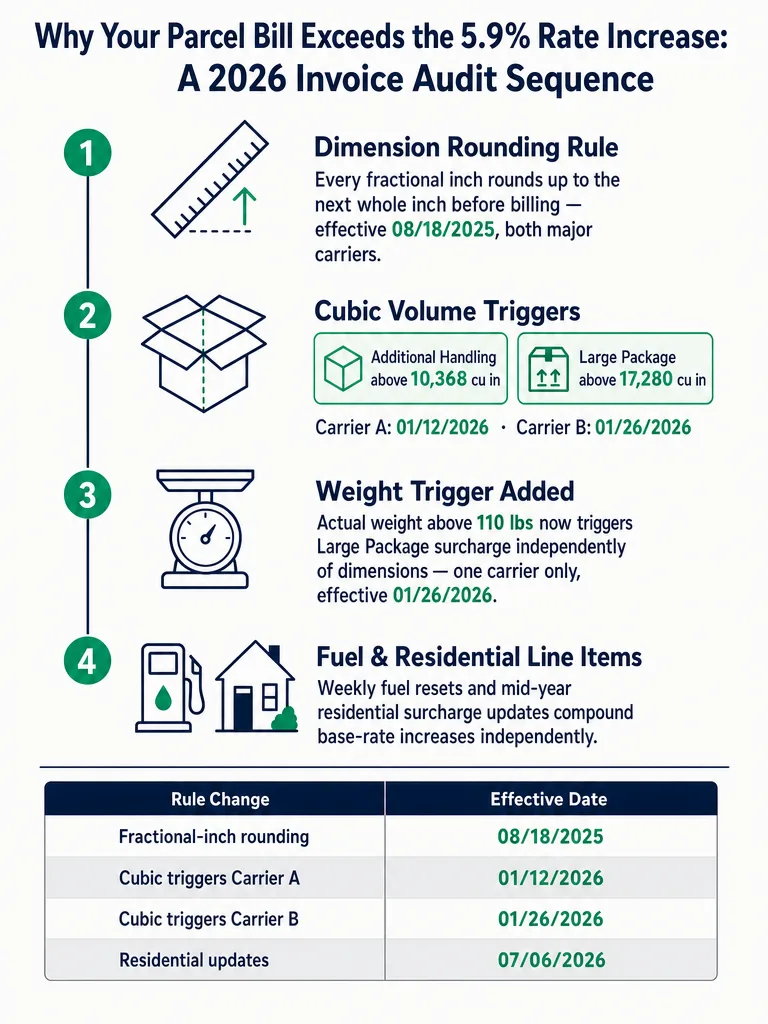
The headline number for 2026 is a 5.9% average general rate increase at both UPS and FedEx, per Ship24, but that figure is the least useful thing on your invoice. The rule changes underneath it decide how much you actually pay. Ship24 reports that both carriers now round fractional dimensions up and added cubic-volume triggers that move ordinary boxes into higher billed weight and surcharge bands.
Here's the short list your audit should start from:
- Fractional-inch rounding on every dimension, live since August 18, 2025, per Ship24.
- Cubic-volume triggers for Additional Handling and Large Package, effective January 2026 at both carriers.
- UPS 110 lb actual-weight trigger for Large Package, added in the January 2026 changes (Ship24).
- Weekly fuel resets that move independent of base rates, per UPS and FedEx.
- July 2026 UPS residential and import/export line increases, reported by FreightWise.
How much are UPS and FedEx rate increases in 2026?
The 5.9% GRI is the base-rate increase, not your total cost increase. LJM reports UPS set its 5.9% average GRI effective December 22, 2025, and FedEx set its 5.9% average effective January 5, 2026. Your billed cost can rise well past that once surcharge eligibility, fuel tables, and dimensional rounding stack on top.
Three separate cost layers move in 2026, and they don't move together:
- Base transportation rates rise the advertised 5.9% on average, per LJM. Your specific lanes and weights can land above or below that.
- Surcharge eligibility shifts because of the rounding and cubic rules, so a package that carried no accessorial in 2025 can carry two in 2026 without any base-rate change.
- Fuel resets weekly against diesel and jet fuel indexes, independent of the GRI entirely.
The carrier's own numbers show the pressure. FreightWise reports FedEx global yield per package rose 11% year over year in fiscal 2026, and U.S. domestic shipment yields rose 10%. That yield growth outpaces the 5.9% average, which tells you the surcharge and fuel layers are doing real work on invoices.
Treat the 5.9% GRI as the floor of your cost increase, not the ceiling.
When did the 2026 UPS and FedEx surcharge changes take effect?
The 2026 changes rolled out across seven months, not on a single date, so your invoice review needs a date map. According to Ship24, the rounding rule went live in August 2025, the cubic triggers landed in January 2026, and FreightWise reports UPS pushed residential and import/export changes in July 2026. Fuel resets weekly on top of all of it.
| Change | Carrier | Effective date | Source |
|---|---|---|---|
| Fractional-inch rounding | UPS and FedEx | 08/18/2025 | Ship24 |
| 2026 GRI (5.9% avg) | UPS | 12/22/2025 | LJM |
| 2026 GRI (5.9% avg) | FedEx | 01/05/2026 | LJM |
| Cubic-volume surcharge triggers | FedEx | 01/12/2026 | Ship24 |
| Cubic-volume surcharge triggers | UPS | 01/26/2026 | Ship24 |
| Residential + import/export line increases | UPS | 07/06/2026 | FreightWise |
| Fuel surcharge resets | UPS and FedEx | Weekly | UPS, FedEx |
Match each invoice line against the date it was billed. A package shipped January 20, 2026 falls under FedEx's cubic rules but before UPS's, so the same carton can bill differently depending on carrier and ship date. That's the detail most surcharge summaries skip, and it's where audit money hides.
How does the August 2025 dimension rounding rule affect UPS and FedEx shipping costs?
Since August 18, 2025, both UPS and FedEx round every fractional dimension up to the next whole inch before running dimensional billing and surcharge tests, per Ship24. A single tenth of an inch can now push a box across a threshold it used to clear. TransImpact walks through exactly how that plays out on a Ground Saver box.
Here's the TransImpact example, unchanged:
- Old rule: dimensions 16.1 x 12.1 x 8.1 measured as-is. Volume 1,536 cubic inches, under the 1,728 cubic inch waiver in the agreement. Actual weight 5 lbs, billed weight 5 lbs.
- New rule: the same box rounds to 17 x 13 x 9. Volume 1,989 cubic inches, over 1,728, so the list DIM factor of 139 applies. Actual weight still 5 lbs, but billed weight jumps to 15 lbs.
Same physical box. Three times the billed weight.
The fix is measuring and recording each dimension precisely, then checking billed dimensions against your actual cartons. Where a box sits a fraction under a threshold, shaving true dimensions or changing packaging can keep it under the divisor entirely.
What are the new cubic volume rules for UPS and FedEx in 2026?
Both carriers added cubic-volume triggers to surcharges that used to depend mainly on linear dimensions and weight. Per Ship24, Additional Handling now triggers above 10,368 cubic inches and Large Package Surcharge triggers above 17,280 cubic inches at both UPS and FedEx. The change is the same in substance; the timing and terminology differ.
| Rule | Threshold | FedEx effective | UPS effective |
|---|---|---|---|
| Additional Handling (cubic trigger) | above 10,368 cu in | 01/12/2026 | 01/26/2026 |
| Large Package / Oversize (cubic trigger) | above 17,280 cu in | 01/12/2026 | 01/26/2026 |
FedEx applies the changes January 12, 2026; UPS applies them January 26, 2026, per Ship24. That two-week gap matters for any package shipped in mid-to-late January, because the same carton can qualify for a cubic-based surcharge on one carrier and not yet on the other.
Terminology also diverges. TransImpact's translation guide notes FedEx uses "Oversize" where UPS uses "Large Package Surcharge (LPS)," and UPS still splits LPS into Commercial and Residential while FedEx charges one Oversize fee across domestic services. When you audit, map the line name to the carrier before comparing amounts.
A box near 10,368 or 17,280 cubic inches deserves a second look every time, because rounding can push it over the line on its own.
What is the Large Package or Oversize threshold for UPS and FedEx in 2026?
Both carriers set the cubic trigger for Large Package and Oversize at 17,280 cubic inches in 2026, per Ship24, but UPS added a second path FedEx does not have: an actual-weight trigger above 110 lbs. A UPS package over 110 lbs now qualifies for Large Package on weight alone, regardless of its cubic volume.
TransImpact confirms the split. UPS packages weighing over 110 pounds now trigger LPS, while FedEx has no weight-based Oversize rule. TransImpact scores that difference as an advantage for FedEx on heavy freight, since the same 115 lb box can carry a Large Package charge on UPS and not on FedEx.
Two consequences for your audit:
- UPS heavy shipments: any package over 110 lbs actual weight should show a Large Package line. If yours don't, or if the weight looks inflated by rounding, flag it.
- Terminology: on FedEx you're looking for "Oversize"; on UPS you're looking for "Large Package Surcharge," and UPS may bill Commercial or Residential LPS at different amounts, per TransImpact.
Public 2026 list prices for these surcharges aren't in the sources here, so audit against your negotiated contract rates rather than an assumed dollar figure.
How do fuel surcharges work for UPS and FedEx in 2026?
Fuel surcharges reset weekly at both carriers and can raise your invoice with no change to base rates. FedEx states its fuel surcharge is subject to weekly adjustment; UPS states the same, adjusting each Monday. Both tie ground services to diesel and air services to jet fuel, using indexes from the U.S. Energy Information Administration.
The service-to-fuel mapping decides which index moves your cost:
| Carrier | Services tied to diesel | Services tied to jet fuel |
|---|---|---|
| FedEx | FedEx Ground, FedEx Home Delivery, FedEx International Ground, pickup services | All other package and express freight services |
| UPS | UPS Ground Domestic, UPS Ground Saver | Domestic air, international air-export and air-import |
Per FedEx, ground and pickup fuel tracks the national U.S. on-highway diesel price, while other services track the U.S. Gulf Coast spot price for kerosene-type jet fuel. UPS mirrors that structure for its Ground and air services.
Recent levels are high. FedEx's published table shows fuel effective 08/31/2026–09/06/2026 of 27.25% for Ground, 29.75% for domestic package services, $0.672 per lb. for domestic express freight, and 41.50% for export and import. FreightWise separately reported UPS ground fuel over 26% and Express fuel over 27% in August, with import and export surcharges around 40%.
Because fuel percentages apply on top of base plus accessorials, a week's diesel move can change your all-in cost more than the annual GRI did. Audit the fuel percentage against the effective date printed on each invoice, not against last month's rate.
Fuel is the fastest-moving line on your invoice, and it's the one most shippers never verify against the published weekly table.
Which UPS residential and import/export surcharge lines changed in July 2026?
UPS raised several U.S. import, export, and residential surcharge lines effective July 6, 2026, per FreightWise. These changes land mid-year, well after the GRI and cubic-trigger rollouts, so they're easy to miss if you audited in January and stopped.
The FreightWise-reported UPS changes, effective 07/06/2026:
| Surcharge line | 2026 amount |
|---|---|
| Extended Area, Pickup Area, Remote Area (import/export) | greater of $61.00 per shipment or $0.61 per lb. |
| UPS Standard Services residential | $6.60 per package |
| UPS International Air Services residential | $6.95 per package |
| UPS 3 Day Select residential | $6.95 per package |
The import/export lines charge the greater of the per-shipment or per-pound amount, so a heavy international shipment can bill on the $0.61 per lb. side rather than the $61.00 flat. Check which basis UPS applied on your heaviest packages.
If your volume skews residential or international, these mid-year increases can quietly reset your per-package baseline. Compare invoices dated before and after July 6, 2026 on the same lanes to isolate the change.
UPS vs FedEx invoice audit order
Audit in the order the rules stack, not the order they appear on the invoice. Because rounding feeds cubic tests, and cubic tests feed surcharge eligibility, checking dimensions first stops you from chasing downstream charges that trace back to one mismeasured box. This sequence turns the scattered 2026 changes into a single workflow.
Work each invoice in this order:
- Dimensions first. Confirm billed dimensions match your actual cartons, and check for fractional-inch rounding that pushed billed weight up, per the TransImpact example.
- Cubic thresholds. Flag any package near 10,368 cu in (Additional Handling) or 17,280 cu in (Large Package / Oversize), per Ship24, and note the carrier's effective date.
- UPS 110 lb exposure. On UPS, verify whether packages over 110 lbs actual weight triggered Large Package, and whether the weight itself is correct.
- Fuel. Match the fuel percentage to the invoice's effective date against the published weekly table from FedEx and UPS.
- Residential and import/export accessorials. Check the July 6, 2026 UPS lines and residential classifications, per FreightWise.
Use TransImpact's terminology guide when comparing carriers: FedEx "Oversize" maps to UPS "Large Package Surcharge," and FedEx Ground Economy and UPS Ground Saver are both Ground Deferred services. Comparing the wrong lines produces the wrong conclusion.
What surcharge prices are not verified in this source set?
Public detail on several 2026 list prices is limited in the sources used here, and naming those gaps keeps your audit honest. No complete official UPS domestic 2026 surcharge list appears in this corpus, and the official FedEx rate-change page returned an error rather than usable content when checked.
Specifically, these figures are not established by the sources here:
- Full official UPS 2026 domestic list prices for Additional Handling, Large Package, Over Maximum, Delivery Area, and Address Correction.
- Full official FedEx 2026 domestic list prices for Additional Handling, Oversize, Unauthorized Package, Delivery Area, and Address Correction beyond the fuel tables.
- A verified official UPS 2026 holiday or demand surcharge schedule. FreightWise notes UPS published 2026 demand surcharges structurally similar to 2025, but the full verified schedule isn't in this corpus.
- Whether specific surcharge lines are discountable under standard or negotiated UPS and FedEx contracts, which depends on your contract language.
Where a dollar figure isn't confirmed here, audit against your own negotiated contract and the carrier's official current rate documents rather than an assumed number. A surcharge line you can't tie to a published amount or contract term is a line to question, not to accept.
When should you compare UPS and FedEx invoices against Amazon Shipping?
Compare against Amazon Shipping when your invoices show heavy lightweight residential ground volume and real surcharge-waiver exposure, not just because published rates look lower. The right comparison is your own invoice data across carriers, since the 2026 rounding, cubic, and residential changes hit lightweight residential parcels hardest.
Pull the comparison when you see:
- A high share of lightweight residential ground packages, where Amazon Shipping can beat UPS or FedEx on cost.
- Repeated residential surcharge lines after the July 6, 2026 UPS increases, where waiver terms change the math.
USPS, DHL, and OnTrac belong in the same multi-carrier view as context. FreightWise notes OnTrac reaches 70% of the U.S. population across 35 states and runs demand surcharges on logic similar to UPS and FedEx, so a regional carrier isn't automatically cheaper. Run the numbers on your actual volume before switching anything.
At Kadima Logistics, we run that comparison off your real invoices, audit each carrier's lines against the 2026 rule changes above, and put the savings in writing before you change a thing.
Frequently asked questions
What is the best way to reduce UPS shipping costs without switching carriers?
Audit dimensions first. The August 18, 2025 fractional-inch rounding rule can triple billed weight on the same physical box — TransImpact shows a 5 lb package billing at 15 lbs after rounding. Fixing one mismeasured carton removes downstream surcharges without changing carriers, lanes, or rates. After dimensions, check cubic thresholds, fuel percentages, and residential lines against your actual invoices and contract terms.
Where can I get a free parcel invoice audit for UPS and FedEx?
Kadima Logistics runs a free shipping audit off your real invoices, checks each carrier line against the 2026 rule changes — rounding, cubic triggers, fuel, and residential surcharges — and puts the savings in writing before you change anything. The audit covers UPS, FedEx, USPS, DHL, and Amazon Shipping. Request it at kadimalogistics.com/contact.
How much are UPS and FedEx rate increases in 2026?
Both carriers set a 5.9% average GRI — UPS effective December 22, 2025, FedEx effective January 5, 2026, per LJM. That's the floor, not the ceiling. FedEx global yield per package rose 11% year over year in fiscal 2026 and U.S. domestic yields rose 10%, per FreightWise, meaning surcharge and fuel layers are driving costs well past the advertised 5.9%.
How does the August 2025 dimension rounding rule affect UPS and FedEx shipping costs?
Since August 18, 2025, both carriers round every fractional inch up before running dimensional billing and surcharge tests. TransImpact's example shows a 16.1 x 12.1 x 8.1 box rounding to 17 x 13 x 9, pushing volume from 1,536 to 1,989 cubic inches and billed weight from 5 lbs to 15 lbs. If your shipping system stores dimensions as approximations, the carrier's rounded measurement will win on the invoice.
What are the new cubic volume surcharge thresholds for UPS and FedEx in 2026?
Additional Handling triggers above 10,368 cubic inches and Large Package triggers above 17,280 cubic inches at both carriers, per Ship24. FedEx applied these January 12, 2026; UPS applied them January 26, 2026. That two-week gap means the same carton can carry a cubic surcharge on FedEx but not yet on UPS for shipments in mid-to-late January — a detail most surcharge summaries skip.
How high are UPS and FedEx fuel surcharges right now?
FedEx published Ground fuel at 27.25% and domestic package services at 29.75% for the week of August 31–September 6, 2026, with export and import at 41.50%. FreightWise reported UPS Ground fuel over 26% and Express over 27% in August, with import and export around 40%. Fuel resets every Monday at UPS and weekly at FedEx, so the percentage on last month's invoice may not match today's.
Sources
- 2026 Parcel Shipping News & Rate Updateswww.freightwisellc.com
- Shipping Rate Changeswww.fedex.com
- UPS vs. FedEx Surcharges 2025: Key Changes and 2026 ...transimpact.com
- Weekly Fuel Surcharge Changeswww.fedex.com
- Fuel Surcharges | UPS - United Stateswww.ups.com
- 2026 UPS & Fedex GRI Cheat Sheetwww.myljm.com
- Parcel Surcharges 2026: The Last-Mile Survival Guide · Pro Fulfillwww.profulfill.com
- 2026 Parcel Pricing: The Changes Beyond the Rate Risewww.ship24.com
Keep reading

One short note, every other Tuesday. Nothing else.
The patterns we're seeing across thousands of carrier invoices, written up tight. Unsubscribe with one click.