Small Parcel Shipping Rates 2026: How to Reach Tiers
Crossing $10,000 a year or 50 packages a week changes what you can negotiate on UPS or FedEx. The real cost gap often comes from surcharges and DIM weight, not the headline rate.
What Shipment Volume Do You Need to Negotiate UPS or FedEx Rates in 2026?
Small parcel shipping rates are the prices carriers charge per package once weight, dimensions, zone, and service level are factored in, and in 2026 your annual spend decides how much of that price is actually negotiable. Shippers spending under $10,000 a year mostly land in automated account tiers, where the carrier's system sets pricing with little room to move on base rates. Cross $10,000 a year in spend, or ship 50 or more packages a week, and you have real negotiating power with a UPS or FedEx account executive who can adjust base rates and surcharge terms directly.
If you're below that threshold, you're not stuck at list price. Platform or marketplace rates that pool many shippers' volume can deliver commercial discounts without any contract commitment. That's the same logic behind GPO shipping rates: shared pricing tied to membership rather than your own volume, which can close much of the gap smaller shippers face against enterprise accounts.
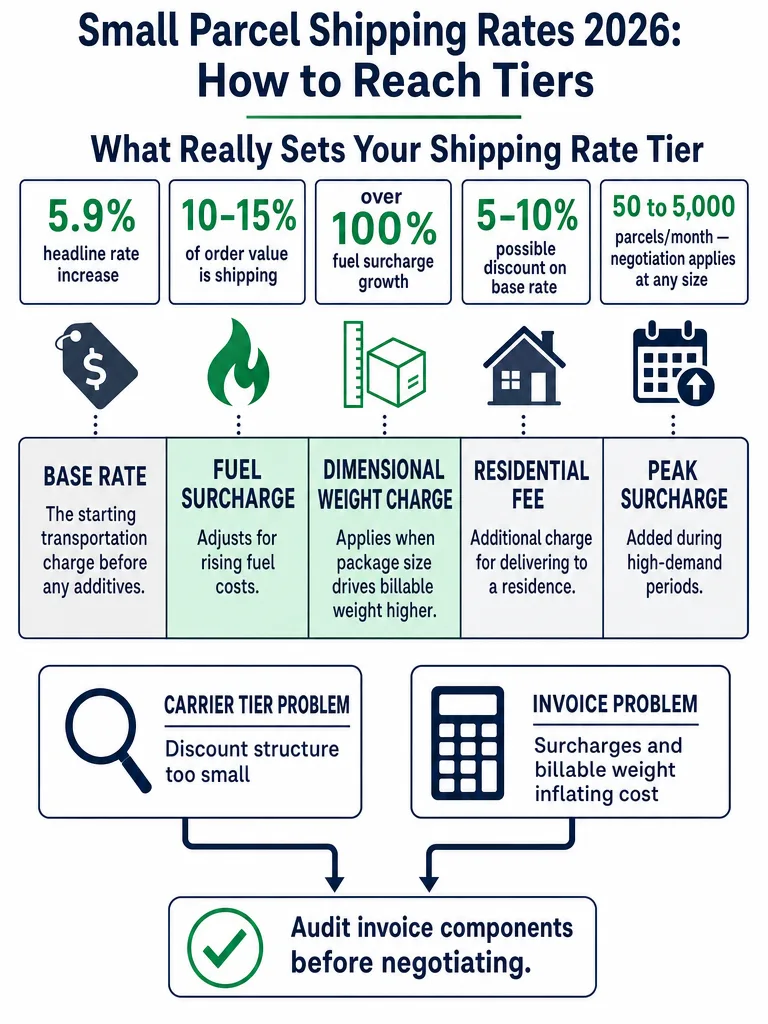
Why Are 2026 Parcel Costs Higher Than the 5.9% Rate Increase?
The published 5.9% general rate increase is not what most businesses actually pay in 2026. UPS, FedEx, and DHL each applied that same 5.9% figure for 2024, 2025, and 2026, but once surcharges compound, most businesses end up paying 8-12% more than the year before, not 5.9%.
The gap comes from what sits underneath the base rate. Fuel surcharges have risen more than 100% in some markets over the last several years, and the current run rate sits around 26% for ground services and up to 27% for express in mid-2026. Those percentages apply on top of the base rate before your discount kicks in on many contracts, which is why a shipper who negotiated a solid base discount can still watch their invoice climb. The GRI is the headline; surcharges are where the real cost increase hides. For the full breakdown of which line items moved this year, see what to audit for in the 2026 UPS and FedEx surcharge list.
How Does Dimensional Weight Push You Into a More Expensive Rate Tier?
Dimensional weight, or DIM weight, means carriers bill you for the higher of actual weight or a weight calculated from box size, and it can move a light package into a much more expensive rate tier without you changing carriers at all. Domestic DIM weight typically uses a divisor of 139: multiply length by width by height in inches, then divide by 139 to get the billable weight.
Run the math on a common box. A 12" x 10" x 8" carton has a cubic volume of 960 inches. Divided by 139, that comes to a DIM weight of 6.9 lbs. If the product inside actually weighs 2 lbs, the carrier still bills you for 7 lbs, rounded up. You're paying to ship empty space.
This is why two shippers with identical published rates and identical negotiated discounts can end up paying very different effective prices. The one with tighter packaging ships fewer billable pounds every time a box leaves the dock.
How Do You Negotiate Shipping Rates With Carriers in 2026?
Negotiating carrier rates in 2026 starts with your own invoice data, not a phone call. The process works best as evidence first, conversation second, because carriers set discounts against your actual shipping profile, not a generic pitch.
- Pull 6-12 months of invoices. Break volume down by service, weight band, zone, and surcharge type. Carriers negotiate against this data; show up without it and you accept whatever they offer.
- Benchmark against your actual profile. Compare your average weight, dimensions, and delivery zones against what similar-volume shippers typically pay, so you know what tier you should sit in.
- Get a competing quote. A rival carrier proposal in hand is still the single most effective lever. An account manager who knows you're comparing offers moves faster and concedes more.
- Negotiate surcharges before the base discount. A 30% base discount means little if fuel and accessorial charges are untouched. Model your effective rate per parcel, not the percentage printed on the cover page.
- Time it deliberately. Push for Q1 or Q2, when carriers compete for volume, and avoid October through December, when they have little reason to concede.
Pulling six to twelve months of invoices and sorting every charge by service, zone, and weight band is the step most businesses skip, because it's slow to do by hand. A free shipping audit does that sorting for you and hands back a written breakdown before you sit down with a carrier.
Is USPS or UPS Cheaper for Small Packages in 2026?
Neither carrier wins across the board in 2026. The cheaper option changes by package weight and delivery address. USPS is typically cheapest for lightweight packages under 1 pound, while UPS Ground often wins for heavier packages headed to commercial addresses. For residential delivery of lightweight items, FedEx Ground Economy (formerly SmartPost) is competitive, and regional carriers can undercut both national carriers by 15-30% within their delivery footprint.
That means a shipper defaulting to one carrier for everything is very likely overpaying on part of their volume. A business shipping a mix of light residential parcels and heavier B2B boxes has no single "cheapest carrier" answer; it has a cheapest carrier per package profile. Routing each package to the most cost-effective carrier through a multi-carrier strategy can save 10-20% immediately, with no negotiation required.
Matching package profile to carrier requires knowing your own weight and zone mix, not a generic rate chart. For the full cost breakdown by weight tier across UPS, FedEx, and USPS, see UPS vs FedEx vs USPS rates 2026 by weight tier.
Can Small Businesses Get Better Parcel Rates Without Enterprise Volume?
Small businesses can get better parcel rates without enterprise volume by using pooled and consolidator programs instead of trying to match enterprise shipping levels on their own. Businesses shipping as few as 200 packages per week can achieve savings that rival what enterprise shippers get. The lever is structure, not size: consolidator and pooled programs cover the 200-2,000 packages-per-week range, letting smaller shippers buy into rates negotiated across many accounts instead of their own.
Amazon Shipping is another option worth comparing directly against your UPS or FedEx invoices for sellers in this range, rather than assuming either carrier is cheaper by default, as covered in when Amazon Shipping beats UPS or FedEx on cost.
GPO-style shared pricing works on the same principle for shippers who don't want to commit to a single carrier's volume tier at all: membership replaces volume as the qualifying factor, detailed further in what GPO shipping rates are and when they make sense. For international or heavier freight mixes, comparing a DHL reseller rate against a direct account follows the same logic: pooled pricing can beat a direct contract until your own volume is large enough to negotiate better alone.
How Do 2026 Peak Season Surcharges Erase Your Negotiated Discount?
UPS and FedEx both layer demand surcharges on top of your negotiated rate every peak season, and in 2026 those charges run higher than last year across nearly every category. UPS's 2026 holiday demand surcharges take effect 09/27/2026 for Additional Handling, Large Package, and Over Maximum charges, and 10/25/2026 for Ground and Air per-package surcharges, running through 01/16/2027. FedEx's 2026 peak surcharges start 09/28/2026 for oversized and additional handling fees, with the rest active by 10/26/2026 through 01/17/2027.
| Surcharge | UPS 2026 Peak | FedEx 2026 Peak |
|---|---|---|
| Ground/Residential per package (peak-of-peak, 11/22-12/26) | $0.60-$0.75 | $0.80 (up from $0.65, a 23% rise) |
| Air per package (peak-of-peak) | $2.05-$2.50 | - |
| Additional Handling | $11.90 | $8.80-$11.85 |
| Large Package Surcharge | $117.50 | - |
| Oversize | - | $95.75-$117.25 |
| Over Maximum Limits | $590 | - |
UPS adds a volume trigger on top of the calendar surcharges. If a shipper's Ground Residential volume hits 175% of their baseline in a single week, every package in that service gets repriced at the higher-volume rate for that week, as high as $2.65 per package.
When Should You Negotiate Carrier Rates in 2026 - Q1 or the Renewal Window?
Carrier rate negotiation in 2026 follows two different clocks depending on your situation: a calendar-driven approach that targets Q1 and Q2, or a renewal-driven approach tied to your contract's actual end date. Which one applies depends on whether you have a fixed renewal deadline or you're negotiating opportunistically.
The calendar-driven view says push for Q1 or Q2, when carriers are competing for volume, and avoid October through December, when they have little incentive to concede. The renewal-driven view ties timing to your contract's actual renewal date instead: start the conversation when you're 60-90 days from renewal, so the carrier knows you have live alternatives before the deadline forces their hand, and start building your case 6-9 months out if your contract end date is fixed, so you have room to gather competing quotes and walk away if the offer isn't strong enough.
In practice, both apply depending on your situation. If you have no immediate renewal deadline, treat Q1 or Q2 as your best opening. If you do have a renewal date on the calendar, start building your case 6-9 months out and force the real negotiation into the 60-90 day window before signing.
Is Your Invoice Showing a Tier Problem or a Surcharge Problem?
Most invoices that look like a "bad rate" are actually a surcharge and DIM-weight problem wearing a rate problem's clothes. Before asking a carrier for a better tier, separate the two: pull the base rate line, then separately total every fuel, residential, delivery-area, additional-handling, and DIM-related charge on the same invoices. A shipping invoice is nearly always a combination of base rate, fuel surcharge, accessorial fees, and dimensional weight charges, each negotiated separately, so a single "average rate" figure hides which piece is actually driving your cost up.
If the base rate is in line with what similar-volume shippers pay but the accessorial and surcharge lines are outsized, the fix is surcharge negotiation and packaging changes, not a new tier. If the base rate itself is high relative to your volume, you have a genuine tier problem worth escalating to an account executive. The same line items are covered in more detail in what to audit for in the 2026 UPS and FedEx surcharge list.
An invoice audit is the fastest way to tell which one you're facing, since it breaks out every charge type across your real shipment history instead of relying on a quoted percentage. Kadima Logistics runs this kind of audit against your actual UPS, FedEx, USPS, DHL, or Amazon Shipping invoices and returns a written breakdown of where the money is going before any negotiation starts. Get your free shipping audit to see that breakdown for your own invoices, here.
Frequently asked questions
What volume do I need to negotiate rates directly with UPS or FedEx in 2026?
You need at least $10,000 in annual shipping spend, or 50+ packages a week, to get real negotiating power with a UPS or FedEx account executive. Below that threshold, carriers place accounts in automated tiers with little room to move on base rates. Platform or marketplace rates that pool multiple shippers' volume can still deliver commercial discounts without a contract commitment.
Why are my 2026 shipping costs higher than the 5.9% rate increase carriers announced?
The 5.9% general rate increase is the headline number, but most businesses actually pay 8-12% more year over year once surcharges compound on top. Fuel surcharges alone run around 26% for ground and up to 27% for express in mid-2026, applied before your negotiated discount kicks in on many contracts. That's why a strong base discount doesn't always show up on the bottom line.
How does dimensional weight affect what carriers charge me?
Carriers bill you for the higher of actual weight or dimensional weight, calculated by dividing length x width x height in inches by a divisor of 139 for domestic shipments. A 12" x 10" x 8" box works out to a 6.9 lb billable weight even if the product inside weighs 2 lbs, rounded up to 7 lbs. Tighter packaging cuts billed weight without changing carriers.
Is USPS or UPS cheaper for small packages in 2026?
Neither wins across the board — the cheaper carrier depends on weight and destination. USPS is typically cheapest for packages under 1 pound, UPS Ground usually wins for heavier commercial deliveries, and regional carriers can undercut both by 15-30% within their footprint. FedEx Ground Economy is competitive for light residential parcels, so routing by package profile beats defaulting to one carrier.
Can a small business get enterprise-level shipping rates without high volume?
Yes — businesses shipping as few as 200 packages a week can access savings that rival enterprise rates through consolidator and pooled programs. These programs cover roughly the 200-2,000 packages-per-week range, letting smaller shippers buy into rates negotiated across many accounts instead of relying on their own volume. Membership or pooling replaces size as the qualifying factor.
When do UPS and FedEx peak season surcharges start in 2026?
UPS's 2026 holiday demand surcharges begin 09/27/2026 for Additional Handling, Large Package, and Over Maximum charges, with Ground and Air per-package surcharges starting 10/25/2026 and running through 01/16/2027. FedEx starts oversized and additional handling surcharges 09/28/2026, with the rest active by 10/26/2026 through 01/17/2027. Both apply on top of your negotiated base rate.
Sources
- 2026 UPS® Rate Guideassets.ups.com
Keep reading

One short note, every other Tuesday. Nothing else.
The patterns we're seeing across thousands of carrier invoices, written up tight. Unsubscribe with one click.