How Much Does DHL Charge Internationally?
DHL does not publish one fixed international price. Your real cost comes from the lane, package size, service level, duties, and surcharges.
How Much Does DHL Charge for International Shipping?
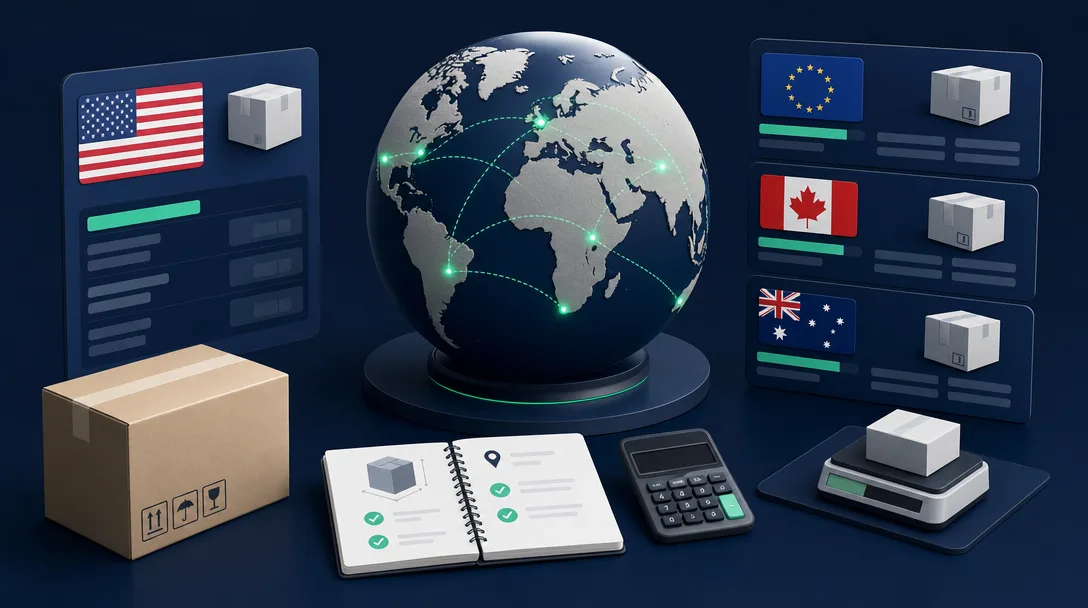
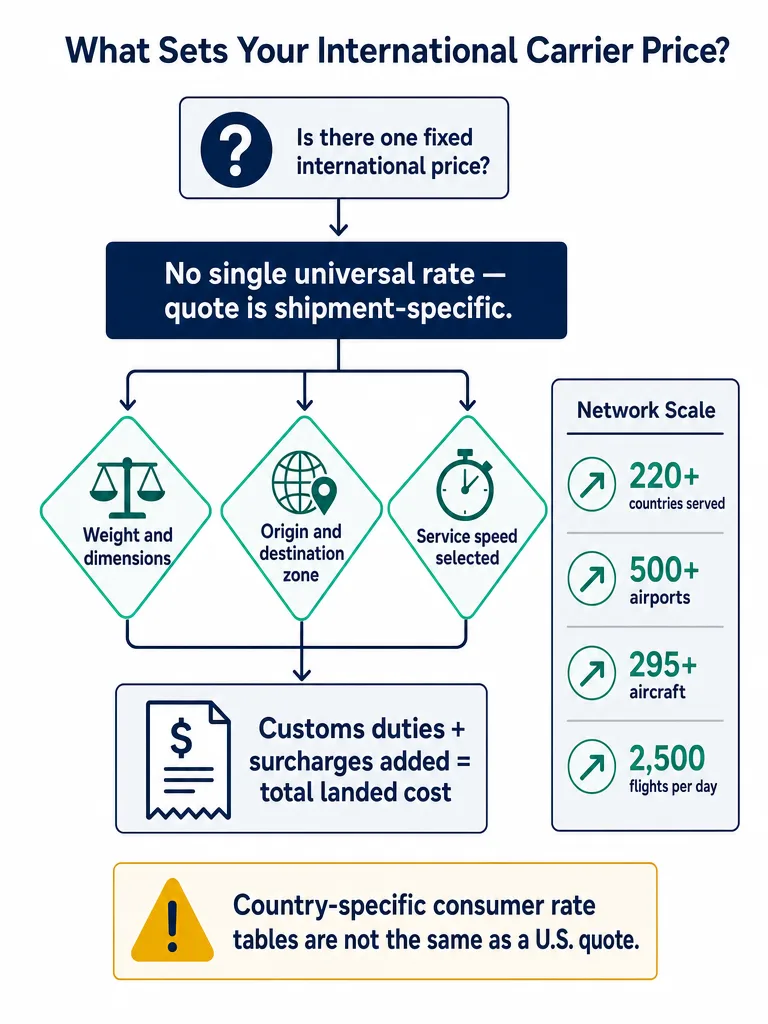
DHL has no fixed international shipping price. The carrier's U.S. quote page says your total depends on origin, destination, package weight and dimensions, service level, customs duties, and surcharges. How much DHL charges for international shipping only becomes a real number once those details run through its own quote tool.
DHL international shipping is DHL's door-to-door delivery service for shipments that cross a border, priced per shipment instead of drawn from one flat published rate card.
That shipment-by-shipment pricing exists because DHL Express runs one of the largest cross-border networks in the world. The carrier serves more than 220 countries and territories, according to its 2026 U.S. Service and Rate Guide, which took effect October 1, 2026. More than 70% of U.S. shipments move through DHL's CVG Hub in Cincinnati before continuing overseas, the same guide says, and DHL is building a $292 million aircraft maintenance facility there to keep that volume moving. A parcel crossing from Cincinnati to Toronto and a parcel crossing from Cincinnati to Manila sit on different zones, different customs rules, and different transit networks, so they rarely land on the same price.
What Information Do You Need to Get a Real DHL International Quote?
Getting an accurate DHL international quote takes five pieces of shipment information, not a glance at a published rate card. DHL's online quote tool and its book-online calculator both ask for the same core inputs before they return a price and a transit estimate.
- Pick a sender type. DHL's booking tool asks whether you're shipping as a business or a "Private Person," since individual shippers can book without an account or contract.
- Enter origin and destination. Add the country, city, or ZIP code on both ends; this sets the pricing zone.
- Describe the shipment. Provide the shipment type, weight, and dimensions. DHL needs all three to calculate the base charge.
- Choose a service. Pick express or a slower option; a registered business account can save these details for repeat shipments.
- Get the instant quote, then book. The tool returns an estimated cost and transit time. Business shippers can book through MyDHL+, DHL's account platform, or drop a prepared package at a DHL ServicePoint location.
What Actually Changes Your DHL International Total
Six variables move your DHL international total before tax: actual weight, dimensional weight, destination zone, service speed, customs duties, and surcharges. DHL's own quote tools treat the first four as the base transportation charge, then itemize duties and surcharges separately so you can see how they inflate the final number.
| Cost factor | What it does to price | Where it shows up |
|---|---|---|
| Actual weight | Heavier packages cost more on the base rate | Base transportation charge |
| Dimensional weight | Large, light packages can bill on size instead of scale weight | Base transportation charge |
| Destination zone | Farther or more complex customs zones cost more per pound | Base transportation charge |
| Service speed | Faster, time-definite delivery costs more than standard transit | Service selection |
| Customs duties | Set by the destination country, not DHL's rate card | Itemized on top of base charge |
| Surcharges | Fuel, remote-area, and handling fees layered onto the shipment | Itemized on top of base charge |
DHL's own get-a-quote tool says it itemizes fees so you can see how customs duties and surcharges affect your total, rather than folding everything into one number up front. That split matters: a shipment's base transportation charge, the weight-and-zone price, can look competitive, while duties and surcharges still push the landed cost well past what you budgeted.
Large, lightweight packages can bill on dimensional weight rather than actual scale weight, and DHL's quote tool lets you adjust size, weight, and delivery speed to see how each change affects the estimate. If you're not sure whether your packaging triggers dimensional weight, check how DIM weight and actual weight are calculated across carriers before you compare a DHL quote against another carrier.
DHL Express vs Country-Specific DHL Rate Tables: Which Numbers Apply to You?
DHL Express pricing for U.S. shippers and DHL's country-specific consumer tables, like its German or Dutch parcel pages, are not the same product. A price published in euros for a German sender reflects a different rate card, currency, and zone map than a U.S. DHL Express quote on the same box.
| DHL product | Built for | Published example | Currency and origin |
|---|---|---|---|
| DHL Express (U.S.) | U.S. businesses and individuals shipping internationally | Price depends on shipment details; the quote tool returns the estimate | USD, United States |
| DHL Germany consumer parcels | German consumers shipping within and beyond Europe | EUR 6.99 to EUR 11.99 for a Päckchen XS up to 2 kg, by zone | EUR, Germany |
| DHL eCommerce cross-border | Dutch senders shipping parcels across EU borders | From EUR 10.90, by destination | EUR, Netherlands |
Each row runs on its own rate card, its own currency, and its own zone map. DHL's U.S. quote pages say pricing depends on origin, destination, package weight and dimensions, and selected service rather than a fixed table. DHL's German site, by contrast, prices a Päckchen XS up to 2 kg at EUR 6.99 for Zone 1 (EU countries), EUR 8.99 for Zone 2 (Great Britain and Switzerland), and EUR 11.99 for Zone 3 (the rest of Europe). None of those euro figures describe what a package costs moving out of a U.S. origin.
What Illustrative International DHL Prices Look Like by Zone and Weight
DHL's published consumer tables outside the U.S. show price scaling hard by destination zone, even when the package stays the same size. These are lane-specific examples from DHL Germany and DHL's Netherlands eCommerce site, not a U.S. DHL Express quote, but they make the zone effect concrete.
On DHL's German consumer price page, the same Päckchen XS up to 2 kg climbs with distance and customs complexity:
| Zone | Covers | Online price |
|---|---|---|
| Zone 1 | All EU countries | EUR 6.99 |
| Zone 2 | Great Britain and Switzerland | EUR 8.99 |
| Zone 3 | Rest of Europe | EUR 11.99 |
Moving from Zone 1 to Zone 3 raises the price of the identical parcel by roughly 72%, with no change in weight or size, just distance and customs handling.
DHL's Netherlands eCommerce site shows the same pattern on cross-border parcels between 0 and 2 kg:
| Destination | Price | Transit |
|---|---|---|
| Belgium | EUR 10.90 | 2 days |
| Germany | EUR 12.15 | 3 days |
| Bulgaria | EUR 30.30 | 6-7 days |
Bulgaria costs nearly three times what Belgium does for the same parcel weight, with transit running four to five days longer. None of these figures are U.S. prices. Treat them as proof that zone and distance move DHL's international pricing hard, then run your own lane through DHL's U.S. quote tool to see where you land.
DHL Reseller vs Direct Account: Which Gets You a Lower International Rate?
Public DHL sources don't settle this question. DHL's own U.S. quote pages and rate guide describe how a single account gets priced, but they don't publish a side-by-side breakdown of pooled reseller pricing against a direct DHL account, and the research behind this article didn't turn up a source that does either.
If you're weighing the two models, the only reliable test is running your actual shipment profile, weight, lane, volume, through both and comparing the quotes line by line rather than assuming one structure wins on paper.
How Do You Get DHL International Rates Below Published Pricing?
Getting a DHL international rate below published pricing starts with your own invoice data, not a better quote screen. Benchmark the rate lines you're already paying, audit surcharges and dimensional weight charges for errors, then compare the same shipment profile across carriers before you book the next shipment.
- Pull your recent DHL invoices. Line up the base transportation charge, customs duties, and every surcharge separately for each shipment.
- Benchmark each lane against DHL's published zone and weight structure. A rate that's off-structure on a lane you ship often is worth flagging, not absorbing.
- Check dimensional weight charges against your actual package dimensions. Oversized or mismeasured boxes get billed at the higher DIM figure, and that error compounds across every shipment on the lane.
- Compare the same shipment profile across DHL, UPS, FedEx, and USPS before booking, so you know whether another carrier beats DHL on that specific lane and weight. Who is cheapest for international shipping in 2026 walks through how that comparison plays out.
- Have someone audit the invoice before you pay it, not after, so billing errors and off-benchmark rates get caught while they're still fixable rather than after they've repeated for months.
Run the comparison with one fixed shipment profile across carriers rather than trusting whatever quote screen loads first. How to compare shipping rates without guesswork walks through that process step by step.
How Does Delivery Speed Change Your DHL International Price?
Time-definite delivery costs more than standard transit on every DHL international lane. DHL Express calls itself the global market leader in Time Definite International shipping in its 2026 U.S. rate guide, and that guaranteed-arrival promise is the premium you pay over slower cross-border options.
Paying for the faster tier makes sense when a missed delivery window costs more than the price difference: a contract deadline, a medical shipment, a customer who's already been told when to expect the box. DHL's own quote calculator is built to compare shipping options by weighing cost against delivery time, according to DHL's U.S. get-a-quote page, so you can see the exact cost difference between a time-definite service and a slower one on your specific lane before you book.
DHL names additional options alongside its core services, including On Demand Delivery, GoGreen Plus, and its MyGTS trade-compliance tool, though public detail on how each affects an international quote is limited as of this writing. Ask DHL directly, or whoever reviews your invoices, which of those are already running on your account before you assume you need to add one.
Frequently asked questions
Does DHL charge international shipping by weight or by package size?
DHL bills international shipments on whichever is higher: actual weight or dimensional weight. Dimensional weight is calculated from a package's length, width, and height, so a large, lightweight box can bill at a higher rate than its scale weight suggests. DHL's online quote tool lets you adjust size, weight, and delivery speed to see exactly how billing weight changes your estimate before you book.
Does a DHL international quote already include customs duties and surcharges?
No, DHL itemizes customs duties and surcharges separately from the base transportation charge rather than folding them into one number up front, according to DHL's own get-a-quote tool. The base charge covers weight, dimensions, and destination zone; duties are set by the destination country, and surcharges cover items like fuel and remote-area handling. Check each line separately before comparing quotes, since a competitive base rate can still carry a high landed cost.
How long does DHL international shipping take?
Transit time depends on destination and service tier rather than one fixed number. On DHL's published European lane examples, a 2 kg parcel reaches Belgium in 2 days but takes 6 to 7 days to Bulgaria, same weight class, different zone. DHL calls itself the global market leader in Time Definite International shipping in its 2026 U.S. rate guide, and its own quote tool returns an exact transit estimate once you enter your package's origin, destination, and weight.
Do you need a DHL account to ship internationally as an individual?
No, DHL's booking tool lets you select "Private Person" as the sender type, which means you can ship immediately without registering for a business account or signing a shipping contract. That path still returns an instant quote and transit estimate, and you can book online or drop a prepared package at a DHL ServicePoint location. A registered business account mainly helps if you ship repeatedly and want to save shipment details.
How do you catch billing errors on your DHL international invoices?
Catching DHL billing errors starts with pulling your invoices and checking the base transportation charge, customs duties, and every surcharge line against the shipment's actual weight and dimensions. Oversized or mismeasured boxes get billed at the higher dimensional weight figure, and that error repeats on every shipment on the same lane until it's flagged. Kadima Logistics audits DHL invoices against negotiated rates and benchmark data to catch these errors before they compound.
Is it cheaper to book DHL international shipping through a reseller than a direct account?
There's no public data that settles this. DHL's own U.S. rate guide and quote tools describe pricing for a single account but don't publish a side-by-side comparison against pooled reseller pricing, and no independent source breaks out that comparison either. The only reliable test is running your actual shipment profile, weight, lane, and volume, through both and comparing the quotes line by line rather than assuming one model wins.
Sources
- service & rate guide 2026www.dhl.com
- DHL Express Service & Rate Guide 2026www.dhl.com
Keep reading
One short note, every other Tuesday. Nothing else.
The patterns we're seeing across thousands of carrier invoices, written up tight. Unsubscribe with one click.