How to Compare Shipping Rates Without Guesswork
Use one fixed shipment profile across USPS, UPS, FedEx, and DHL so you compare total cost, not a misleading quote screen. Then check surcharges and dimensional weight.

How Do You Compare Shipping Rates Across Multiple Carriers?
Comparing shipping rates correctly means requesting quotes with identical shipment details, same origin, destination, actual weight, package dimensions, and delivery window, from every carrier you check, then judging full cost and transit promise together, not the lowest number on a quote screen. That's how to compare shipping rates across USPS, UPS, FedEx, and DHL.
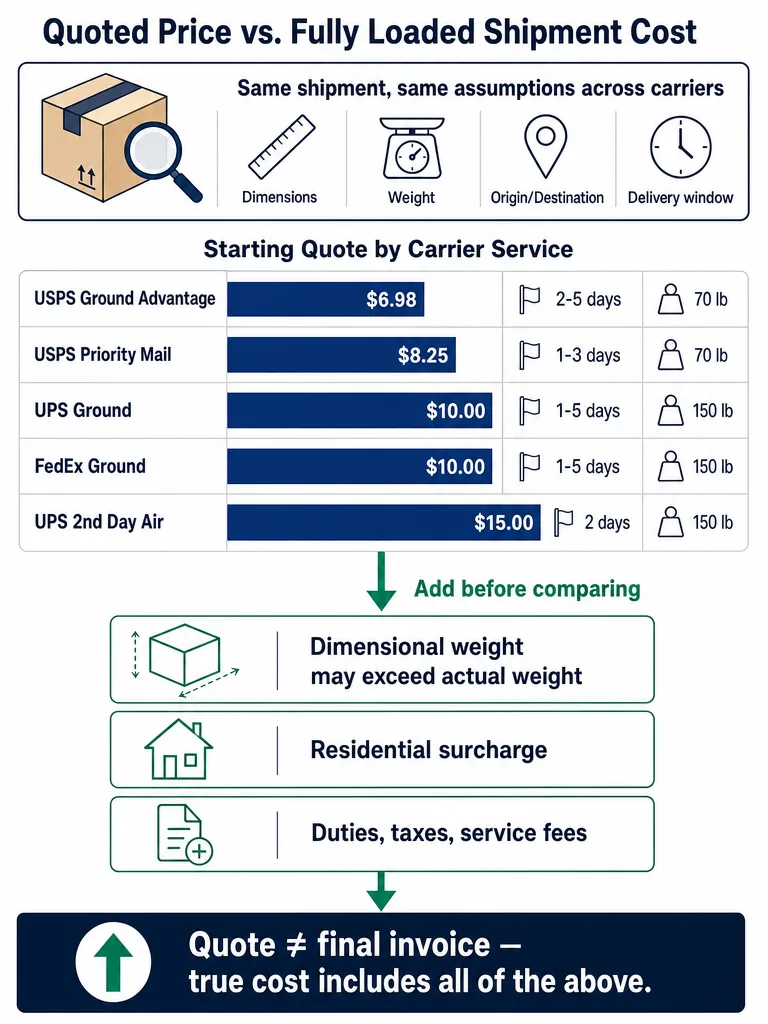
That rule cuts out a common shortcut: pulling a cheap ground rate from one carrier and an expedited rate from another, then calling the ground option "cheaper." It also rules out comparing a headline base price from one calculator against a fully loaded quote from another. USPS, UPS, FedEx, and DHL each price the same box differently depending on weight, dimensions, zone, and service level, so the only fair test is running one shipment profile through every carrier's own rules and adding every charge that applies before you compare totals.
Skipping this step is how businesses end up locked into the wrong carrier for part of their volume. A rate that looks cheapest on a single test package can lose once the box gets heavier, the zone changes, or a residential address enters the picture.
What Shipment Details Do You Need Before Requesting Quotes?
A valid rate comparison starts with a fixed shipment profile: origin and destination ZIP codes, actual packed weight, final box dimensions, residential or commercial status, pickup or drop-off method, required delivery window, and declared value. Small differences in any of these inputs can change a quote enough to distort the result, so lock every field before requesting a single rate from USPS, UPS, FedEx, or DHL.
- Origin and destination ZIP codes, plus country and residential or commercial status.
- Actual weight of the packed shipment, including the box and packing materials, not the product alone.
- Final length, width, and height of the box as it ships, not the product's own dimensions.
- Pickup or drop-off assumption, since rates can differ by collection method.
- Required delivery window, such as a guaranteed date versus a standard transit estimate.
- Declared value and any optional services, such as signature confirmation or extra coverage.
Run that same profile through USPS, UPS, FedEx, and DHL before comparing a single price, and note the quote date next to each result. Rates and surcharges change often enough that a quote from last month isn't a reliable stand-in for today's price.
Are Shipping Fees Determined by Weight or Package Dimensions?
Carriers bill the greater of a package's actual weight and its dimensional weight, so a large but light box can cost more than its scale weight suggests. Dimensional weight estimates how much space a parcel takes up in a truck or aircraft, and it's calculated as length times width times height, divided by a carrier-set divisor. The lower that divisor, the more a package gets billed for its size rather than its scale weight.
USPS tightened its own dimensional weight divisor from 166 to 139, for packages larger than one cubic foot, effective July 2026, which raises billable weight on larger, lighter boxes. Take an 18 by 14 by 8 inch box, 2,016 cubic inches. Under the old USPS divisor of 166, that box comes out to 12.1 lb of billable weight. Under the new divisor of 139, the same box comes out to 14.5 lb, about 20% more billable weight for an identical package.
A box's billed weight can jump 20% overnight when a carrier changes a single divisor number, with nothing about the package itself changing.
What Other Charges Change the Real Cost of a Shipment?
The quoted price on a shipping calculator rarely matches the final invoice, because carriers add charges on top of the base rate: residential delivery surcharges, fuel-related charges, dimensional weight adjustments, and for international shipments, duties, taxes, and brokerage fees. Separating these categories out before calling one option cheaper is the only way to compare the full cost of a shipment, not just its sticker price.
| Charge category | What it covers | Why it's missed in a quote |
|---|---|---|
| Residential delivery surcharge | Extra fee for delivering to a home address | Calculators often default to commercial pricing |
| Fuel-related charge | Adjustment tied to current fuel costs | Shown as a separate line, not folded into the headline price |
| Dimensional weight charge | Billing based on box size, not scale weight | Calculator uses product weight unless you enter the final packed dimensions |
| International duties, taxes, brokerage | Customs charges owed on the shipment's value | Excluded from the quoted transportation price entirely |
Two of these gaps repeat on nearly every shipment, not just occasional ones. A calculator that assumes a commercial address understates cost for anyone shipping to homes, and a quote run on product dimensions instead of final packed dimensions understates dimensional weight across an entire catalog. Auditing existing invoices for these charges before negotiating or switching carriers is the fastest way to see which surcharges are already showing up on a bill.
Standard, Negotiated, or Flat-Rate: Which Should You Compare?
Three different pricing structures can apply to the same package, and comparing only one of them against a competitor's number skews the result. Published rates are the sticker price anyone gets with no account history. Negotiated or account rates are discounted off that sticker price once a shipper reaches a carrier's volume or spending threshold. Flat-rate services price by box size and speed instead of weight or zone at all.
UPS Simple Rate is the clearest flat-rate example: five package size tiers running from $12.20 to $30.95, covering boxes up to 1,728 cubic inches, about one cubic foot, and 50 lb, for domestic US shipments, according to UPS's own developer documentation. That flat price beats standard weight-and-dimension pricing for dense, boxable shipments that would otherwise get billed heavily for their size, and it stops working the moment a package crosses that size or weight limit.
| Rate type | Who qualifies | When it's cheaper |
|---|---|---|
| Published rates | Anyone with no account history | Rarely the cheapest; it's the baseline you compare against |
| Negotiated / account rates | Shippers that reach a carrier's volume or spend tier | Cheaper once volume and weight mix match the discount tier |
| UPS Simple Rate (flat) | Any US domestic shipper, box up to 1,728 cubic inches, 50 lb | Cheaper for mid-size, boxable shipments that price high under standard weight and size rules |
The catch for most small and mid-size shippers is that negotiated rates sit behind reaching specific volume or spend tiers that larger shippers clear automatically. Comparing your current rate against the published rate, not against another shipper's negotiated number, is the only fair way to tell whether you're actually getting a discount.
What Are Starting Rate Examples for USPS, UPS, and FedEx?
Starting prices for a small package vary widely across carriers because each one prices by its own mix of weight, zone, and dimensional rules, not a shared price list. Getting a true side-by-side number for one specific package means running the same weight, dimensions, and zone through each carrier's own calculator, since a generic "starting from" figure for one service rarely matches another service's starting point for the identical box.
UPS Simple Rate is the one flat, publicly documented price point available without an account: five tiers from $12.20 to $30.95 for boxes up to 1,728 cubic inches and 50 lb, according to UPS's own developer documentation. USPS and FedEx price most services by weight and zone instead of a flat box-size tier, so a true match against UPS Simple Rate requires checking whether the USPS or FedEx weight-and-zone price for that same box lands above or below the flat rate.
The only reliable way to answer "what would this exact box cost on each carrier" is to request a quote with identical weight, dimensions, origin, and destination directly from each carrier, then compare the resulting totals rather than a generic published starting price. How the gap between UPS, FedEx, and USPS rates changes by weight tier is worth checking before assuming one carrier wins across your whole shipping profile.
What Is the Cheapest Way to Ship Internationally?
Economy service is typically the cheapest way to ship internationally, but it's also the slowest, and the quoted transportation price is never the full cost. Duties, taxes, brokerage fees, and currency conversion have to be added to that base price before one option can fairly be called cheaper than another.
The bigger risk with international comparisons is stopping at the shipping line of the quote. A service that looks less expensive on transportation alone can end up costing more once customs charges and brokerage fees land on the same invoice, particularly on lanes handled by DHL or other international carriers that bill duties and brokerage separately from the base transportation charge. Build those costs into the comparison before choosing a service level, not after the shipment clears customs.
How Often Should You Re-Run Your Rate Comparison?
Rerun your shipping rate comparison regularly, and immediately after any carrier announces a rate or surcharge change, because the inputs behind a quote don't stay fixed. USPS's dimensional divisor change in July 2026, from 166 to 139, is a concrete example: a comparison run in June would have priced the same box lower than one run in August, with nothing about the package itself changing.
The cheapest carrier also shifts by package profile, not just by date. A lightweight residential parcel that favors one carrier this quarter can favor a different one once volume, zone mix, or surcharge schedules shift. When Amazon Shipping comes in cheaper than UPS or FedEx depends on exactly this kind of package-level comparison, run against current rates rather than a snapshot from months earlier.
A one-time comparison goes stale the first time a carrier updates a price list or divisor. Pairing a recurring rate check with a regular review of actual carrier invoices, not just published prices, catches both rate changes and billing errors that a single comparison misses. Treat the exercise as a repeating check, not a one-time project, so pricing changes get caught before they compound into months of overspend.
Frequently asked questions
Can a small business qualify for negotiated shipping rates without hitting a carrier's high volume threshold?
Yes, small businesses can get close to negotiated-rate pricing by routing volume through a partner that aggregates multiple shippers' spend, since carriers set volume and spend tiers that few standalone small shippers clear on their own. Kadima Logistics works this gap directly, using GPO-style pricing and account negotiation to get smaller shippers rates closer to what high-volume shippers pay, without requiring the shipper to hit that volume alone.
How do you check whether your current carrier invoice already includes billing errors or hidden overcharges?
Compare each invoice line item against the service you actually booked, checking for residential surcharges applied to commercial addresses, dimensional weight charges based on the wrong box dimensions, and fuel or accessorial fees that don't match the shipment. Carriers bill in high volume, and small account-level mistakes compound monthly if no one checks the invoice against the actual shipment data and the rate that should have applied.
Does declared value change the shipping rate you're quoted?
Yes, declaring a shipment value above a carrier's included coverage amount adds a separate charge for extra liability protection on top of the base transportation rate. Two otherwise identical quotes can differ once one box carries a higher declared value than the other. Matching declared value and optional services like signature confirmation across every carrier you check is part of building a fair side-by-side comparison, not a detail to add later.
Is an online shipping rate calculator enough to find the best price?
No, a calculator gives a starting estimate, not a final price, because most default to commercial addresses and bill by product weight instead of final packed dimensions. That understates cost for anyone shipping to homes or using boxes larger than the product inside them. Treat a calculator result as a first pass, then confirm the number against each carrier's own account rules and the full set of surcharges that apply to your shipment.
Should you compare carrier rates using one shipment profile or several different package sizes?
Run more than one shipment profile, because the cheapest carrier for a light residential parcel is not necessarily the cheapest for a heavier or larger box from the same business. A single test package can make one carrier look like the overall winner when it only wins for that specific weight, zone, and dimension combination. Testing your two or three most common box sizes against every carrier gives a comparison that holds up across real volume.
Can Amazon Shipping be cheaper than UPS or FedEx for the same package?
Yes, for specific package profiles, Amazon Shipping rates can undercut UPS or FedEx, but no single carrier wins across an entire shipping mix. Which one comes out cheapest depends on the package's weight, zone, and service level, the same variables that decide pricing differences among UPS, FedEx, and USPS. Running the identical shipment profile through Amazon Shipping alongside the major carriers is the only way to confirm which one actually wins for your packages.
Keep reading



One short note, every other Tuesday. Nothing else.
The patterns we're seeing across thousands of carrier invoices, written up tight. Unsubscribe with one click.