Who Is Cheapest for International Shipping in 2026?
The cheapest international carrier changes by lane, weight, and service tier. This guide shows where UPS, FedEx, USPS, and DHL win—and when duties or surcharges erase the savings.

Who is the cheapest carrier for international shipping?
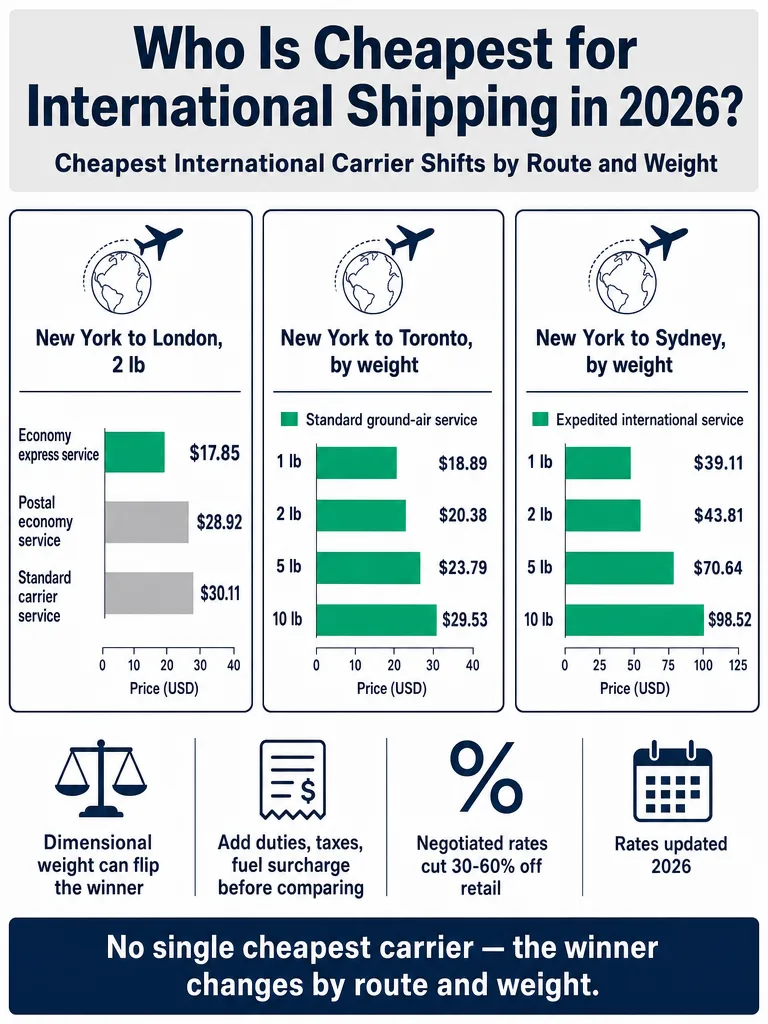
No single carrier is cheapest for international shipping in 2026. The lowest price shifts by destination, weight, and service tier. A 2026 rate comparison refreshed October 20 found UPS Standard cheapest for a 1-pound package shipped from New York to Toronto at $18.89, while UPS Worldwide Expedited won the same weight to Sydney, starting at $39.11.
That same comparison holds across every weight tested. UPS Standard stayed cheapest to Toronto through 10 lb, topping out at $29.53. On the Sydney lane, UPS Worldwide Expedited climbed to $98.52 at 10 lb, with USPS priced close behind at the lightest weights ($39.16 at 1 lb) but never the lowest option in that dataset.
The pattern flips again on lighter packages leaving North America. A separate 2026 multi-carrier rate comparison for a 2-pound shipment from New York to London found FedEx International Connect Plus priced lowest at $17.85, ahead of USPS First Class International at $28.92 and UPS Worldwide Expedited at $30.11 on that specific lane.
International shipping rates run on zone, weight band, and service class, not carrier reputation. A carrier can be the cheapest option to Canada and the second-most-expensive option to the UK on the same day, for the same box. That's the real answer behind who is cheapest for international shipping: it depends on your lane.
UPS vs FedEx vs USPS vs DHL: which wins by route?
The cheapest international carrier changes by destination, not by brand loyalty or market share. UPS wins outright on the Canada lane in US-origin rate data, and a separate Western Europe pricing matrix shows DHL, UPS, and FedEx landing close together on the Europe-to-USA route specifically.
A 2026 live-rate comparison for shipments originating in New York, refreshed October 20, priced the following by destination and weight, in US dollars and pounds:
| Destination | Weight | Cheapest option | Service | Price |
|---|---|---|---|---|
| Toronto, Canada | 1 lb | UPS | Standard | $18.89 |
| Toronto, Canada | 5 lb | UPS | Standard | $23.79 |
| Toronto, Canada | 10 lb | UPS | Standard | $29.53 |
| Sydney, Australia | 1 lb | UPS | Worldwide Expedited | $39.11 |
| Sydney, Australia | 5 lb | UPS | Worldwide Expedited | $70.64 |
| Sydney, Australia | 10 lb | UPS | Worldwide Expedited | $98.52 |
On these two lanes, UPS won at every weight sampled. USPS priced close behind on the lightest Sydney shipments, at $39.16 for 1 lb, but didn't take the top spot at any weight tested on either route.
A separate pricing matrix covers a different scenario entirely: a 5 kg parcel shipped from Western Europe, priced at 2026 retail rates rather than the discounted US-origin commercial rates above. For that route and weight only, Parcel Guide's 2026 international courier comparison lists these retail estimates:
| Carrier | Western Europe to USA, 5 kg, retail estimate |
|---|---|
| DHL Express | €65-85 |
| UPS | €60-80 |
| FedEx | €60-78 |
On this specific Western Europe-to-USA lane, Parcel Guide's comparison put DHL, UPS, and FedEx within 15% of each other, a tighter spread than the US-origin dataset above, where UPS beat the next-closest option by a wider margin on both routes. The two tables aren't directly comparable; they use different origins, different weight units, and retail pricing versus discounted commercial rates. But together they show the same underlying point from two angles: the cheapest carrier depends on exactly which route and rate type you're pricing.
If you ship across several of these lanes regularly, a weight-tier breakdown by carrier shows where your mix is already overpaying.
What's the cheapest way to ship a small package internationally?
Postal and economy express services are usually the cheapest way to ship a small international package, generally anything under 4.4 lbs. Some lanes break that pattern: in a 2026 multi-carrier rate comparison for a 2-pound shipment from New York to London, FedEx International Connect Plus priced lowest at $17.85, ahead of USPS First Class International at $28.92 and UPS Worldwide Expedited at $30.11.
A small international package is generally defined as anything under 2 kg, or about 4.4 lbs, the threshold most carriers use to price an entirely different service tier than heavier boxes, according to Parcel International's 2026 shipping guide. Below that line, postal economy services consistently compete with, and often beat, private express carriers on price.
Comparison guides in 2026 repeatedly place USPS First Class International, or similar postal economy products, among the lowest-cost options for shipments under 4.4 lbs. That holds partly because postal carriers route through the Universal Postal Union, a United Nations specialized agency founded in 1874 that coordinates mail exchange between member countries' national postal services. Public postal networks don't need to price for the same margin private couriers do, which keeps small-parcel rates lower on many routes.
The tradeoff is speed and tracking. Postal economy services typically run slower and offer thinner tracking once a package leaves the origin country, which is why an express carrier's economy product, like FedEx International Connect Plus, can still beat postal pricing on specific lanes. There's no fixed small-package winner; the lightest weight band is where postal economy and express economy services actually compete head to head, lane by lane.
Is the cheapest listed rate still cheapest after duties and surcharges?
Often not. The number on a carrier's rate page is the base shipping charge, not the landed cost of the shipment. Duties, import taxes, fuel surcharges, and residential delivery fees stack on top of that base price, and major carriers added an average 5.9% rate increase in 2026 on top of what shippers already pay, according to Parcel International's small-box shipping guide.
That same source points to a bigger structural shift behind the math: the suspension of the $800 US de minimis exemption, which had let many low-value international shipments cross the border duty-free. With that exemption gone, a shipment that used to clear with no duty can now carry a customs charge that erases most of the savings from picking the cheapest-looking carrier.
Surcharges are where a lot of that erosion hides, and they rarely show up until the invoice lands. Checking your contract against a carrier's current surcharge list before assuming a quoted rate is the real price catches most of that gap before it reaches your bill.
Retail rates vs negotiated account rates: which number should you trust?
The retail rate card is not what most shippers actually pay. Volume accounts and negotiated pricing can cut the published rate by 30 to 60%, according to Parcel Guide's 2026 international courier comparison, which means two businesses shipping the identical box on the identical lane can see a two-to-one gap in what they're charged.
That gap can apply to premium service tiers too. UPS Worldwide Saver, UPS Worldwide Express, FedEx International Priority, and USPS Priority Mail Express International are built for speed rather than the lowest sticker price. None of the sources behind this comparison break out negotiated discount percentages specifically for those premium tiers, so the safest approach is checking your own account's negotiated rate for each tier rather than assuming the 30 to 60% figure applies evenly across services.
One flat-rate product that can't answer this question at all: UPS Simple Rate. UPS's own flat rate shipping page confirms the service is limited to shipments within the 50 US states, so it isn't a candidate for an international price comparison no matter how competitive its domestic pricing looks.
The only way to know which number applies to you is checking it against your own invoices, not a published rate card. That's the task behind comparing shipping rates properly: pulling your actual billed rate and testing it against current carrier benchmarks for your weight and lane, a step Kadima Logistics builds into its invoice audits. A fixed-shipment comparison method walks through how to run that check yourself.
Will dimensional weight change which carrier is actually cheapest?
Yes. Carriers bill whichever is higher: a package's actual weight or its dimensional weight, calculated from the box's length, width, and height, according to Parcel International's 2026 shipping guide. That single rule can change which carrier is cheapest for the exact same shipment.
Dimensional weight exists because carriers need to account for the space a package takes up on a truck or plane, not just what it weighs on a scale. A light, bulky box and a dense, compact box of identical actual weight can price differently once dimensional weight enters the calculation, since the dimensional figure is based on size rather than scale weight. Parcel International's 2026 guide lists optimizing box dimensions among the standard ways to cut small-parcel shipping costs, a sign of how much the dimensional weight rule affects the final charge.
A rate comparison based on weight alone, without checking the box's dimensions, gives an incomplete answer. The carrier that prices lowest for a given actual weight isn't necessarily the carrier that prices lowest once the box's size is factored into the bill.
How to choose the cheapest international carrier for your shipment
Picking the cheapest international carrier takes five checks, run in order. Skipping any one of them is how shippers end up paying more than the "cheapest" label suggested.
- Lock down the lane and weight band first. Canada, the UK, Australia, and continental Europe each produced a different cheapest carrier in the 2026 rate comparisons above. There's no answer until you know the destination and the weight.
- Match the service tier to your actual speed need. Economy postal and economy express products undercut priority and express tiers substantially; paying for UPS Worldwide Saver or FedEx International Priority speed you don't need erases any savings from choosing the "cheap" carrier.
- Price the landed cost, not the sticker price. Add duties, fuel surcharges, and residential fees before declaring a winner, especially now that the $800 US de minimis exemption no longer shields low-value shipments from customs charges.
- Compare the retail rate card against what you're actually billed. A negotiated or volume account rate can run 30 to 60% below retail on the same lane, so the published price is rarely the real decision point.
- Check your own invoices before switching anything. The cheapest carrier on a sample calculator often isn't the cheapest for your real shipment mix once your existing negotiated rates, surcharge history, and weight distribution are factored in.
Reviewing those invoices is the step most shippers skip, mostly because pulling negotiated rates and surcharge history out of a carrier portal takes time most teams don't have. A closer look at reducing shipping costs without switching carriers covers what that invoice review typically turns up.
Before You Book in 2027
Carrier pricing on these lanes moves with each general rate increase and zone update, so the October 2026 figures above are a snapshot, not a forecast for 2027.
- Pull a fresh quote from each carrier's own rate tool for your exact origin, destination, and weight.
- Confirm whether the carrier's most recent general rate increase or zone chart update has taken effect on your lane.
- Check current duty and customs thresholds, since those rules can change independently of carrier rates.
- Recalculate dimensional weight if your package size or the carrier's DIM divisor has changed.
Frequently asked questions
Is USPS or UPS cheaper for international shipping?
UPS priced lower than USPS on every lane and weight tested in a 2026 rate comparison, though USPS came close on the lightest shipments. A New York-to-Sydney comparison refreshed October 20 showed USPS at $39.16 for a 1-pound package, just five cents above UPS Worldwide Expedited's $39.11, but USPS never ranked lowest at any weight on that route or the Toronto lane. Check your specific lane before assuming either carrier wins by default.
Is FedEx or UPS cheaper for international shipping?
FedEx beat UPS on a specific lightweight lane in 2026 rate data: FedEx International Connect Plus priced a 2-pound New York-to-London shipment at $17.85, compared with $30.11 for UPS Worldwide Expedited on the same route. UPS won on other lanes instead, pricing lowest at every weight tested for New York-to-Toronto and New York-to-Sydney shipments. Neither carrier is cheaper across the board; the winning carrier depends on the destination and weight.
Which carrier is cheapest for shipping to Canada?
UPS Standard priced lowest for New York-to-Toronto shipments at every weight tested in a 2026 rate comparison refreshed October 20, starting at $18.89 for 1 pound and reaching $29.53 at 10 pounds. No other carrier in that dataset, including USPS or FedEx, beat UPS Standard on the Canada lane at any weight sampled. That consistency makes Canada one of the more predictable international routes to price.
Which carrier is cheapest for shipping to Australia?
UPS Worldwide Expedited priced lowest for New York-to-Sydney shipments across every weight tested in a 2026 rate comparison, starting at $39.11 for 1 pound and climbing to $98.52 at 10 pounds. USPS priced close behind at the lightest weight, $39.16 for 1 pound, but didn't take the top spot at any weight sampled on that route. Confirm current pricing before booking, since rates on this lane shift fast with weight.
Does UPS Simple Rate work for international shipments?
No. UPS Simple Rate is a flat-rate domestic product limited to shipments within the 50 US states, according to UPS's own flat rate shipping page, so it cannot be compared against international carriers or used to price a cross-border shipment. Its five box tiers range from $12.20 to $30.95 for US-only delivery. Shippers pricing international lanes need UPS's standard zone-and-weight-based international services instead.
What happened to the $800 de minimis exemption for international shipments?
The exemption was suspended in 2026, ending duty-free treatment for many low-value international shipments that previously crossed the US border without customs charges, according to Parcel International's 2026 shipping guide. Combined with an average 5.9% carrier rate increase the same year, the change means a shipment that once cleared with no duty can now carry a customs charge that erases most of the savings from picking the cheapest-looking carrier.
Keep reading



One short note, every other Tuesday. Nothing else.
The patterns we're seeing across thousands of carrier invoices, written up tight. Unsubscribe with one click.