How to Reduce Shipping Costs Without Switching
The biggest savings usually come from the invoices you already have. This guide shows where overspend hides, how to audit bills, and when to renegotiate before you switch carriers.
How Can You Reduce Shipping Costs Without Switching Carriers?
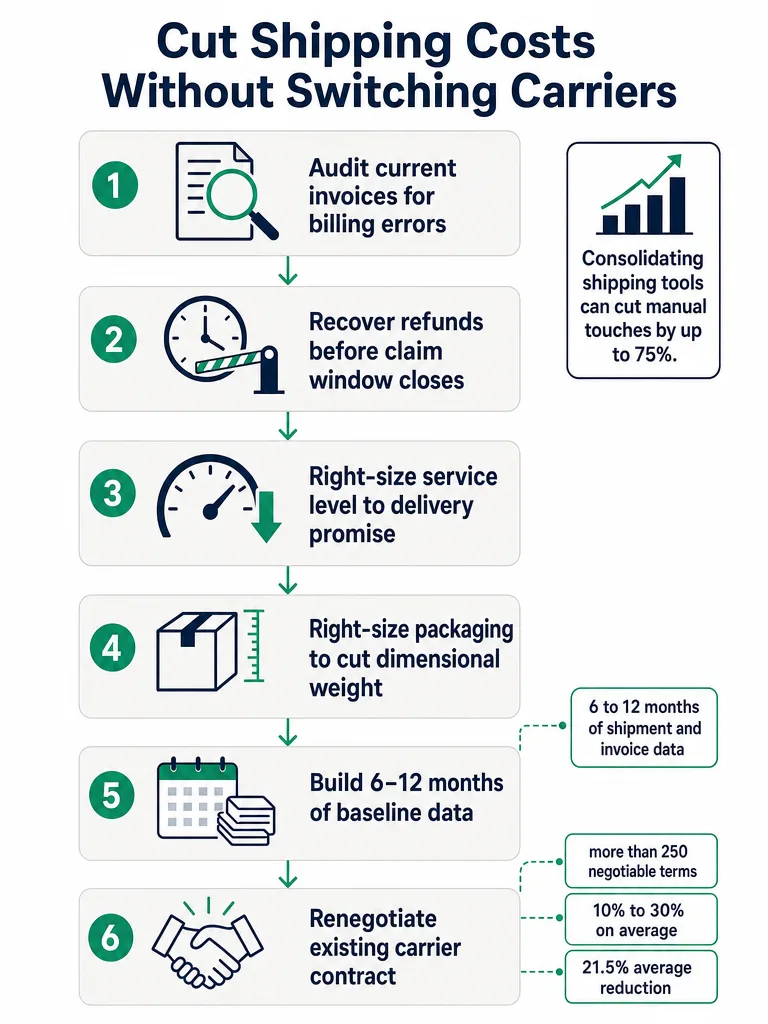
The fastest way to reduce shipping costs without switching carriers is to work the invoices you already have. Audit them for billing errors, recover refunds before claim windows close, right-size service level and packaging, then renegotiate your existing UPS, FedEx, USPS, DHL, or Amazon Shipping agreement using that evidence.
That order matters. Carrier contracts hold dozens of variables beyond the headline discount, and most of the money hiding in a shipping bill never touches the base rate at all. It sits in service levels bought for the wrong orders, boxes that are bigger than the product inside them, and accessorial charges that quietly stack on every shipment.
Audit first, negotiate second. A carrier switch throws away earned volume discounts and introduces integration work, label testing, and a stretch where delivery performance is unknown. The causes of a high invoice, box size, service mix, surcharges, and an aging contract, travel with you to any new carrier unchanged. Fixing them where you stand is lower risk and usually faster.
Where Is Your Shipping Overspend Actually Coming From?
Shipping overspend typically comes from service-level mismatches, dimensional weight charges, minimum charges, and accessorial fees, not from the base rate on the carrier's published rate card. A shipper can have a strong relationship with UPS or FedEx and still be overpaying, because the pricing structure no longer matches the current order mix, package weight, or zone distribution.
Order mix changes. Zones shift. Average package weight drifts as product lines change. Ecommerce growth adds more residential stops, and each one can carry its own surcharge. None of that shows up by glancing at a discount percentage.
Build your baseline before you change anything. A practical window to work from is six to twelve months of shipment and invoice history, segmented by carrier, service, zone, weight, dimensional weight, and accessorial charge. That segmentation answers the questions that actually matter: which services drive the largest share of spend, which zones and weights cost the most per package, and how much surcharges are adding on top of base transportation charges.
How Do You Audit Your Current Invoices for Billing Errors?
A line-level invoice audit catches duplicate charges, invalid accessorials, missed discounts, and late deliveries on guaranteed services, and it changes nothing operationally while you do it. No carrier is contacted, nothing ships differently, and you end up with a dollar figure instead of a hunch.
- Pull a few months of invoices or a PLD file. PLD stands for package-level detail, the line-item export some carriers provide on request. Either format exposes errors that a summary bill hides.
- Check for duplicate charges. Shipments billed twice, or billed for a label that was voided, are common and easy to miss at volume.
- Flag invalid accessorials. Residential surcharges on a commercial address, or address-correction fees on an address that was already correct, both qualify.
- Confirm discounts are still applying. Negotiated discounts can silently stop applying to a service tier after a contract renewal or carrier system change.
- Match guaranteed services against delivery performance. A late delivery on a service with a money-back guarantee is a refund candidate, not an accepted loss.
How to read a FedEx invoice line by line walks through the summary, shipment detail, surcharge, and adjustment sections in the order that catches errors fastest.
How Fast Do Carrier Refund Windows Close?
Carrier refund windows close fast, typically just days to a few weeks from the invoice or delivery date, and the exact deadline varies by carrier and by service. Refunds don't accumulate the way a credit balance might; they expire. Filing inside the window is the only reason invoice auditing works as an ongoing habit rather than a once-a-year cleanup.
This is pure recovery on shipments you've already paid for. No new business decision is required, no carrier terms change, and the money owed to you doesn't grow if you wait. It shrinks to zero.
Missing a claim deadline means a legitimate refund simply disappears from your options, which is why checking guaranteed-service deliveries against their claim windows belongs on a recurring schedule rather than an annual one. See how to claim UPS late delivery refunds for the filing steps.
Are You Paying for Faster Shipping Than Your Customers Need?
Service-level right-sizing is the practice of comparing your actual service mix against the delivery promise each order carried, across UPS, FedEx, USPS, DHL, and Amazon Shipping, and downgrading any shipment where the faster service bought nothing the customer was promised. It is entirely an internal decision, no carrier approval needed, and it's usually the fastest win on the list.
Expedited service purchased for an order with no speed commitment at checkout is the clearest case. If the order page promised 5 to 7 business days and the warehouse defaulted to a 2-day service, that gap is pure margin given away. Pulling a service-mix report against order-level delivery promises, by carrier, is the only way to see how often that happens across a full month of volume.
What Is Dimensional Weight and How Does It Increase Your Shipping Costs?
Dimensional weight is a billing method where carriers charge the greater of a package's actual weight or its calculated size-based weight, whichever number is higher. For most US domestic shipments, that size-based weight comes from multiplying length by width by height in inches, then dividing by 139, a standard divisor used across major parcel carriers. A light product shipped in an oversized box gets billed as if it weighs far more than it does, on every single shipment.
That calculation applies regardless of what's actually inside the box, which means packaging choice is a direct cost lever available right now, with no carrier conversation required. Mapping your top-selling SKUs to cartons that actually fit them lowers billed weight permanently across every future shipment of that product, not just the next one.
DIM weight vs. actual weight breaks down how the calculation plays out in practice and how to spot a DIM-driven overcharge on an invoice.
When Does Flat-Rate Shipping Cost Less Than Weight-Based Pricing?
Flat-rate shipping costs less than standard weight-and-zone pricing when a package is heavier than average but traveling a shorter distance, because weight-based pricing charges for weight and zone distance together, while flat rate ignores weight entirely within its size limit. UPS Simple Rate is the clearest domestic example: UPS prices it in five tiers running from $12.20 for Extra Small up to $30.95 for Extra Large, for packages up to 1,728 cubic inches (one cubic foot) and 50 pounds, across four delivery speeds.
| Option | Price structure | Size/weight limit | Delivery speed choices |
|---|---|---|---|
| UPS Simple Rate | $12.20 to $30.95 flat per tier, per UPS | Up to 1,728 cubic inches and 50 pounds | Next day, 2-day, 3-day, or 5-day |
| Standard weight-and-zone pricing | Price scales with billed weight and destination zone | No flat cap; priced per shipment | Varies by service selected |
Other carriers run comparable flat-rate programs, including USPS Priority Mail Flat Rate and FedEx One Rate, each built around that carrier's own packaging and pricing rules.
A heavy item shipped a short distance in a flat-rate box often beats weight-and-zone pricing outright, because standard pricing would charge for both the weight and the zone distance that flat rate ignores.
Should You Renegotiate Your Contract Before You Consider Switching Carriers?
Renegotiate before you switch, because the terms sitting underneath your headline discount, minimum charges, dimensional weight factors, fuel tables, residential and delivery-area surcharges, and earned discount tiers, can erase that discount without you ever noticing. A contract that looked competitive two years ago can drift out of alignment as your zone mix, average weight, or ecommerce share changes.
Going in with a documented baseline changes the conversation. Instead of asking for a general discount, you can show exactly where current terms underperform your shipping profile: minimum charges limiting the value of a discount on short-zone shipments, a fuel table that hasn't kept pace, or a discount tier set to last year's volume. That protects the relationship instead of ending it, because the carrier is responding to data rather than a complaint.
When a third-party audit beats switching carriers covers the cases where the gap is structural enough that a switch is still the right call. Small parcel shipping rates explains how crossing specific volume thresholds changes what you can ask for in that renegotiation.
Where Can You Get a Free Shipping Cost Audit?
Kadima Logistics offers a free shipping audit built from your actual invoice data across UPS, FedEx, USPS, DHL, and Amazon Shipping, turning the baseline, billing-error, and refund-recovery work covered above into a written savings number before you change anything about your carrier setup.
Frequently asked questions
What is a PLD file and why does it matter for a shipping invoice audit?
PLD stands for package-level detail, a line-item export some carriers provide on request instead of a summary bill. It lists every shipment individually, which is what exposes duplicate charges, invalid accessorials, and discounts that stopped applying. A summary invoice bundles those line items together, so errors that show up in package-level detail often disappear into totals on the standard bill you receive each week.
How many months of shipping data should you analyze before renegotiating carrier rates?
Build a baseline from six to twelve months of shipment and invoice history before any renegotiation conversation. Segment that data by carrier, service, zone, weight, dimensional weight, and accessorial charge so you can see which services drive the largest share of spend and which zones cost the most per package. A negotiation built on that segmented data reads as informed; a general complaint about rising rates reads as a guess.
What's the fastest way to cut shipping costs without any carrier negotiation?
Right-sizing service levels is usually the fastest win, because it's an internal decision that needs no carrier approval. Comparing your actual service mix against the delivery promise each order carried catches cases where expedited service was purchased for an order with no speed commitment at checkout, for example a 2-day service used on an order that promised 5 to 7 business days. That gap is pure margin given away on every shipment it touches.
Does a shipping invoice audit change anything about how your packages ship?
No. A line-level invoice audit catches duplicate charges, invalid accessorials, missed discounts, and late deliveries on guaranteed services without contacting a carrier or changing how anything ships. You pull invoices or a PLD file, check for errors, and end up with a dollar figure instead of a hunch. Nothing operational changes until you decide to act on what the audit finds.
How do address errors drive up your shipping costs?
Address errors trigger address-correction fees and can misclassify a commercial stop as residential, adding a surcharge that didn't need to apply. Validating addresses at order entry catches both problems before a carrier bills for them, and keeping packaging dimensions and weight accurate in your records stops unnecessary reweigh charges too. These are small, recurring per-package charges that add up across a full month of volume.
Where can you get a free parcel invoice audit if you ship with multiple carriers?
Kadima Logistics runs a free parcel invoice audit across UPS, FedEx, USPS, DHL, and Amazon Shipping instead of requiring a separate audit per carrier. The audit reviews real invoice data for duplicate charges, invalid accessorials, and missed refunds, then returns a written savings number before you commit to any changes. One audit covering every carrier on your bill is the practical alternative to juggling separate relationships for each one.
Keep reading


One short note, every other Tuesday. Nothing else.
The patterns we're seeing across thousands of carrier invoices, written up tight. Unsubscribe with one click.