Residential vs Commercial Surcharges: What to Audit
Audit address type and Delivery Area Surcharge separately on every UPS or FedEx invoice. The same shipment can carry both charges, and commercial addresses are often billed wrong.
What's the difference between a residential surcharge and a delivery area surcharge?
Auditing residential and commercial surcharges on a UPS or FedEx invoice means checking four things: whether the address earned its residential surcharge correctly, whether a commercial address got billed as residential by mistake, whether the destination ZIP sits on that carrier's current Delivery Area Surcharge list, and whether the invoice charged the extended DAS rate instead of the standard one.
There's no separate "commercial surcharge" line item on a UPS or FedEx invoice. The commercial side of this problem shows up in two places instead: an address that should be classified commercial getting billed as residential, and a ZIP Code that should fall under DAS Commercial or Extended DAS Commercial getting billed under the pricier residential category. Both errors move money the wrong way, and both hide inside line items that look routine.
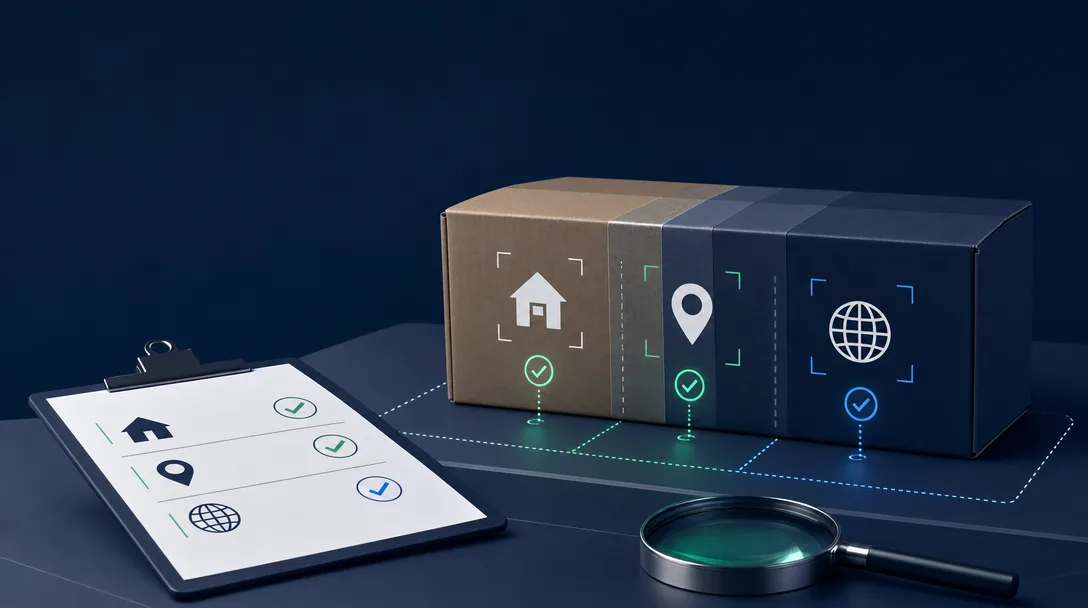
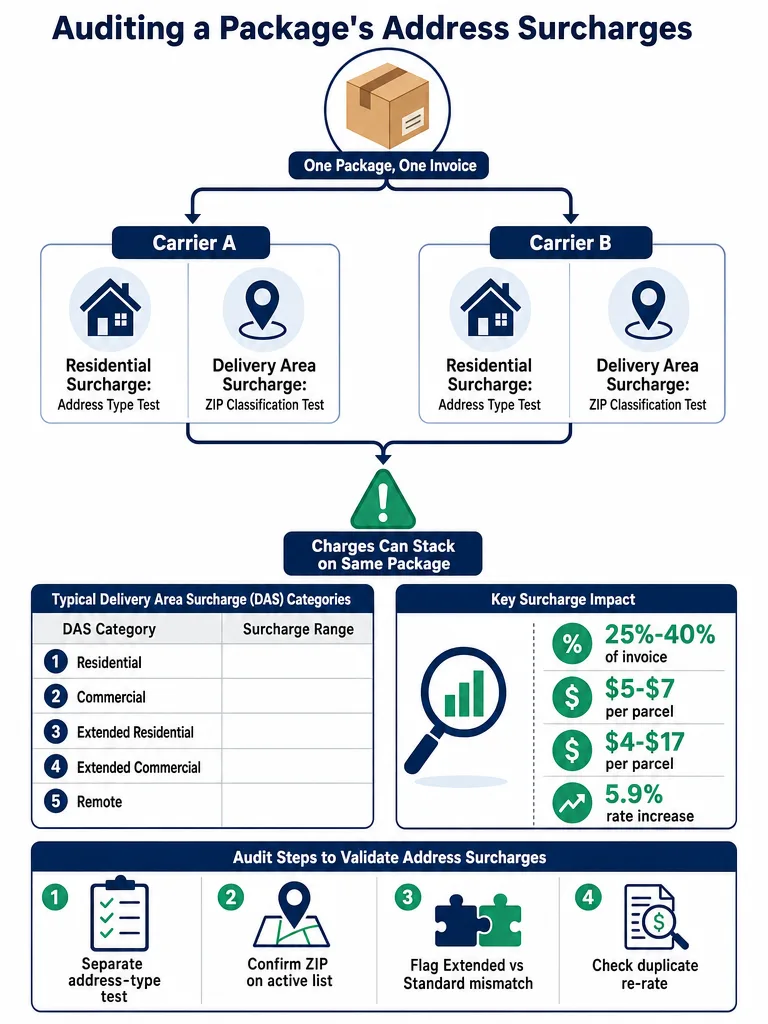
A residential surcharge is a fee UPS and FedEx apply when a package is delivered to a home, a private residence, or a business run out of a home. A Delivery Area Surcharge is a different charge entirely: it's tied to the destination ZIP Code's classification on the carrier's own list, not to whether the stop is a house or a business. The two triggers are independent, so a single package can carry both a residential surcharge and a DAS line on the same invoice.
That distinction matters because you audit the two charges through different data. Residential status comes from how the carrier codes the consignee's dwelling type. DAS status comes from a quarterly ZIP Code list covering residential, commercial, extended, and remote zones. Because the two systems run separately, they don't always move together: a ZIP can drop off one carrier's DAS list at the start of a new quarter while the same address keeps its residential classification with both carriers.
Treat residential surcharge accuracy and DAS eligibility as two different audit tests, even when both charges land on the same package. That's where most invoice reviews miss money.
How do UPS and FedEx decide if an address is residential or commercial?
UPS and FedEx each run their own address classification system, built and maintained independently. That's why the same delivery point can come back coded residential at UPS and commercial at FedEx, or the reverse, for the exact same building.
Neither carrier publishes the full rule set behind that classification, and the available research for this piece doesn't document the specific factors UPS or FedEx weighs for edge cases like a home-based business, a shared office suite, or a mixed-use building. What's confirmed is the structural point: the two systems are separate, they draw on different address and delivery data, and they don't always agree on the same street address.
UPS and FedEx don't share one address classification system, so the same building can be residential to one carrier and commercial to the other. If you run volume through both carriers to the same set of delivery addresses, expect some disagreement between how each one codes those stops. That's not a data error on your end to fix. It's two independent systems reaching two independent conclusions, which is exactly why testing address classification carrier by carrier, rather than assuming one carrier's coding applies to the other, belongs in a proper audit.
Can a commercial address get billed as a residential surcharge?
Yes. Office parks, mixed-use buildings, and multi-suite locations are the addresses most often billed with a residential surcharge in error, because a carrier's classification file doesn't always match a specific unit's current business status. This is one of the more disputable line items on a UPS or FedEx invoice, and it's worth checking before you assume the charge is correct.
Misclassification tends to cluster in a few patterns: a business that moved into space previously used as a residence, a shared-suite address where several companies operate under one street number, and any address where the carrier's file still lists an outdated or unregistered business name. None of that changes the fact that the delivery point is commercial. It means the carrier's file hasn't caught up.
A commercial address billed as residential is one of the more winnable disputes on a parcel invoice, but only if you can show the address operates as a business. The available research for this piece doesn't spell out exactly what documentation UPS or FedEx requires to approve a reclassification. As a practical matter, pulling together whatever proof you have that the address functioned as a business at the time of delivery, such as a current business license or a lease showing commercial use, gives a dispute more to work with than a plain request to recode the address. Confirm what each carrier actually wants directly through your account rep or the carrier's own billing support before you file.
The same address-data problem shows up in a different form on FedEx's address correction fee, where an outdated or incomplete address record triggers a different charge for a similar underlying reason: the carrier's file is stale, not the address.
Does the delivery area surcharge stack with the residential surcharge?
Yes. A rural residential ZIP Code can carry both a residential surcharge and an extended Delivery Area Surcharge on the same package, stacking two address-related fees on top of each other before fuel or any additional handling charge gets added. UPS and FedEx each use a similar five-category DAS structure, but the specific rates and the ZIPs inside each category are set separately by carrier and shift every quarter.
| DAS category | What triggers it | How it typically compares |
|---|---|---|
| DAS Residential | Residential ZIP on the carrier's active quarterly list | Higher than DAS Commercial |
| DAS Commercial | Commercial ZIP on the carrier's active quarterly list | Lower than DAS Residential |
| Extended DAS Residential | Outer residential zones, farther from a delivery hub | Higher than standard DAS Residential |
| Extended DAS Commercial | Outer commercial zones, farther from a delivery hub | Higher than standard DAS Commercial, lower than Extended DAS Residential |
| Remote Area Surcharge | Hawaii, Alaska, US territories, and other hard-to-reach ZIPs | Highest of the five categories |
Treat this table as a guide to the five-category structure, not a rate card. Actual dollar amounts move by carrier, contract, and quarter, so verify current rates against your own invoice rather than a published estimate. The pattern that matters is the stack itself: a package going to a rural home sitting inside an extended DAS zone can be billed for the residential surcharge and Extended DAS Residential together, two address-related fees layered onto one shipment before fuel or any oversize charge is added.
The full list of what else changed on 2026 invoices, beyond residential and DAS, is broken down in the 2026 UPS and FedEx surcharge list.
How to audit residential and DAS charges on the same invoice
Running this audit means testing six things on every shipment that carries a residential or DAS line: invoice format, address-type accuracy, DAS ZIP eligibility, extended-versus-standard DAS category, duplicate billing, and your dispute deadline. Treat each as a separate check, since an error in one category rarely shows up when you're only screening for another.
- Pull invoice data at the shipment level. Download the invoice in a line-item format, not a lump accessorial total, so every surcharge is its own row you can test on its own.
- Test address type on its own. For every shipment carrying a residential surcharge, check whether the consignee address is actually a home or a business address the carrier miscoded.
- Test DAS ZIP eligibility separately. Cross-reference the destination ZIP Code against the carrier's current quarterly DAS list for the invoice date, not a list from a prior quarter, since ZIPs move on and off these lists.
- Flag Extended DAS billed where standard DAS should apply. This is one of the more common category errors: a ZIP sits on the standard DAS list, but the invoice charges the higher extended rate anyway.
- Check for duplicate charges and re-rates. The same shipment billed twice for a base rate or a surcharge is easy to recover once flagged, and it's also commonly missed on a manual pass.
- Confirm your dispute window before filing. UPS and FedEx each give shippers a limited window to dispute billing errors, misapplied surcharges, or duplicate charges, and a separate, typically shorter window for service-guarantee refund claims tied to a late delivery. Check the current deadline in your carrier's own billing portal before you submit anything, since the window varies by carrier and by claim type.
Run consistently, this kind of line-by-line address and ZIP audit can recover a meaningful share of annual parcel spend. The exact percentage depends on your shipment mix, address quality, and how many quarters of invoices go unchecked, but address-type and DAS-category errors are two of the places a single manual review tends to miss.
Are surcharge increases outpacing the general rate increase enough to matter?
Yes, and it's the surcharge side of the invoice that does more damage over time. UPS and FedEx each publish one headline general rate increase a year, but residential and delivery-area fees get adjusted on their own schedule, and they don't always move in step with that headline number.
That gap is why shipping costs creep up every year without anyone noticing. A residential fee that climbs by a few cents doesn't get announced the way a general rate increase does. It shows up two or three invoices later as a higher cost per parcel, and by then it's baked into the budget as normal. On many ecommerce invoices, surcharges and accessorials add up to a substantial share of the total bill, not just the base transportation charge, which is why an audit that only checks the headline rate misses most of the actual cost movement.
The base rate is the number carriers publicize, and the surcharges are the number that actually moves your total spend. That holds whichever carrier carries your volume, UPS, FedEx, USPS, or DHL.
For a closer look at how a headline increase translates to an actual invoice, see how a UPS general rate increase hits small shippers.
How to reduce residential and DAS surcharge exposure without switching carriers
Reducing residential and DAS exposure starts with how a shipment gets routed, not which carrier hauls it. The main levers are consolidating multi-item orders into fewer stops, redirecting eligible packages to a pickup point the carrier codes as commercial, offering in-store pickup where you have retail locations, and testing lower-cost ground services built for lightweight residential volume. None of this requires moving volume to a new carrier.
- Consolidate multi-item orders into one shipment. Bundling orders headed to the same address cuts the number of billed residential stops, which cuts the number of times the surcharge applies.
- Redirect eligible orders to a pickup point. UPS Access Points and FedEx Drop Box locations count as commercial stops, which removes the residential surcharge entirely on that package.
- Offer BOPIS where you have retail locations. Buy-online-pickup-in-store removes the last-mile residential leg altogether and gives shoppers a checkout option many of them already prefer.
- Test Ground Economy or SurePost-style hybrid services for eligible zones. These lower-cost ground options are built for lightweight residential volume and can carry a different fee structure depending on the service and zone.
- Audit before you decide which lever to pull. Not every shipment qualifies for every fix. Checking which addresses, ZIPs, and order patterns actually drive your residential and DAS charges tells you which of the levers above will move your invoice and which won't.
None of these fixes require moving volume to a new carrier, but they only work if you know which addresses and ZIPs are actually driving the charges. Checking your own invoice data against the five levers above, rather than guessing, is the most direct way to find out where residential and DAS charges are adding up on your account.
Frequently asked questions
What is a residential surcharge on a UPS or FedEx invoice?
A residential surcharge is a fee UPS and FedEx add whenever a package is delivered to a home, a private residence, or a business run out of a home. It sits on top of the base shipping rate to cover the added cost of last-mile delivery to a residential stop versus a commercial one. It applies independently of the Delivery Area Surcharge, so a single package can carry both charges on the same invoice.
Does a home-based business get charged a residential surcharge?
Yes. UPS and FedEx both code a business operating out of a home as a residential stop, since the surcharge is tied to the delivery address type, not the nature of the business. That holds even if the business has a registered name or license, because the underlying address is still a private residence. A dispute only works if you can show the address is actually a separate commercial unit, not simply that a business operates there.
How often do UPS and FedEx update their Delivery Area Surcharge ZIP lists?
UPS and FedEx each refresh their Delivery Area Surcharge ZIP lists on a quarterly basis, four times a year. Because the update schedule runs separately from residential address classification, a ZIP Code can drop off one carrier's DAS list at the start of a new quarter while the same address keeps its residential status with both carriers. Checking the invoice date against the current quarter's list, not last quarter's, is the only way to confirm a DAS charge is still valid.
Roughly how much does a residential surcharge cost per package?
Residential delivery fees typically run in the $5 to $7 range per package, based on parcel industry data, though the exact figure depends on your carrier, contract, and the current quarter's published rate. UPS and FedEx set their own residential rates separately, and both have pushed increases on residential fees faster than their yearly general rate increase in recent years. Check your own invoice rather than a published estimate, since neither carrier prices identically.
Is there a deadline to dispute a misapplied residential or DAS surcharge?
Yes, and the window differs depending on the type of claim. UPS and FedEx each set a limited period to dispute billing errors or misapplied surcharges, and a separate, typically shorter window for service-guarantee refund claims tied to a late delivery. Neither deadline is universal across claim types, so confirm the current window directly through your carrier's billing portal before filing, rather than assuming last quarter's rule still applies.
Where can you get a free audit of residential and DAS surcharges on your invoice?
Kadima Logistics offers a free shipping audit that reviews real invoice data for residential surcharge misclassification, DAS ZIP errors, duplicate billing, and other overcharges, then delivers a written savings analysis. The review works across UPS, FedEx, USPS, DHL, and Amazon Shipping without requiring you to switch carriers. Because residential and DAS errors hide inside routine-looking line items, a line-by-line review is the most reliable way to catch them before the dispute window closes.
Keep reading


One short note, every other Tuesday. Nothing else.
The patterns we're seeing across thousands of carrier invoices, written up tight. Unsubscribe with one click.