How to Separate a Carrier Billing Error From a Valid Surcharge
Use the worksheet to decide whether a charge is supported, potentially misapplied, or unresolved. Gather the missing evidence before filing a dispute, and check the carrier's deadline first.

How do you separate a carrier billing error from a valid surcharge?
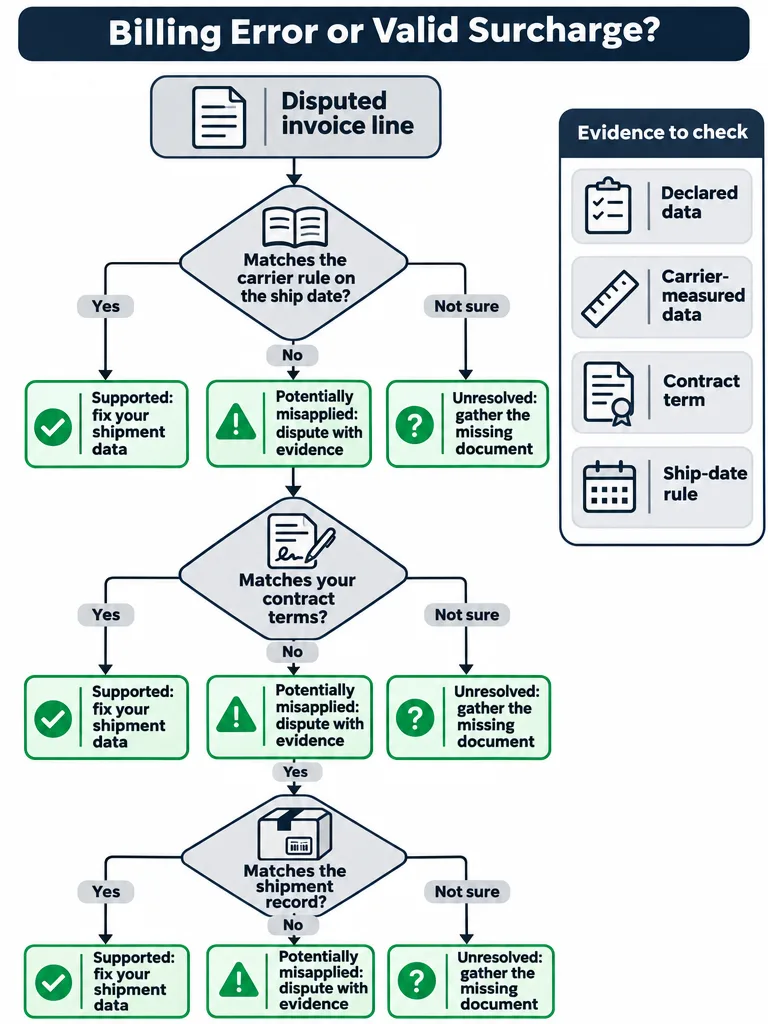
To separate a carrier billing error from a valid surcharge, test the charge against the carrier rule in effect on the ship date, your signed contract, and the shipment record. It is an error only if it contradicts one of them, valid if it matches all three, and unresolved if evidence is missing.
An invoice that differs from the label price is not yet an error. Each test needs its own document:
- Rule test: do the carrier's terms for the ship date allow this charge on this shipment?
- Contract test: do your signed agreement and amendments change, cap, or waive the charge?
- Shipment-record test: do the declared and carrier-measured data (weight, dimensions, address, service) support the charge?
Classify the charge as unresolved until the missing rule or contract provision is obtained.
The public sources behind this piece don't include carrier-primary surcharge rules, so it states no thresholds or rates. It gives you the method for applying the rules you pull from your own carrier terms.
What evidence do you need before you call a charge an error?
Evidence for one disputed invoice line means five things: the tracking number and invoice line, the declared label-time data, the carrier-measured data, your signed agreement with amendments, and the carrier terms in effect on the ship date. Mark each item as documented or assumed. Only documented items count.
- Identifiers: tracking number, invoice number, and the specific invoice line.
- Amounts: the billed amount and the amount you expect to owe, with the reason for the gap.
- Label-time data: declared weight, dimensions, destination address, address type, and service level as sent when the label was created.
- Carrier-measured data: the weight, dimensions, or address classification the carrier says it used.
- Contract documents: your signed agreement and every amendment, including surcharge discounts or waivers.
- Carrier terms by ship date: the UPS, FedEx, USPS, DHL, or Amazon Shipping terms effective on the day the package shipped, not today's version.
To locate these fields on a FedEx bill, read a FedEx invoice line by line. It works through the invoice summary, shipment detail, surcharges, and adjustments in that order.
How do you label each invoice line as supported, misapplied, or unresolved?
Label each invoice line by comparing five records: the invoice line, your declared data, the carrier-measured data, the contract term, and the ship-date rule. A line is supported only when the evidence in each column backs the charge and its amount. It is potentially misapplied when documented evidence contradicts it, and unresolved when any column lacks evidence.
The entries below are illustrative placeholders, not carrier thresholds or rates.
| Invoice line | Declared data | Carrier-measured data | Contract term | Ship-date rule | Evidence status | Verdict |
|---|---|---|---|---|---|---|
| Residential charge | Address recorded as commercial | Carrier classed it residential | Waiver clause not located | Rule text not pulled | Contract, rule, and address classification all unchecked | Unresolved |
| Dimensional (DIM) weight adjustment | Carton dimensions in your system, possibly stale | Carrier reports a larger carton | No cap located yet | Rule text pulled, calculation not yet run | Trigger is plausible; measurement and billed amount unverified | Unresolved (leans supported) |
| Possible duplicate | One label printed | Same tracking number on two invoice lines | Not applicable | Not applicable | Charge records not yet compared | Unresolved (leans misapplied) |
Walk through the first row. The invoice bills a residential charge on an address you recorded as commercial. The declared and carrier records conflict, and neither is conclusive on its own. Test each against corroborating shipment evidence, such as packing or address records. Then pull the rule and check the contract for a waiver. If the rule allows the charge, no waiver exists, and the evidence supports the carrier's classification, the row becomes supported. If the contract waives it or the evidence contradicts the classification, the row becomes potentially misapplied.
The other two rows follow the same logic. A larger carton on the carrier's record is a trigger, not proof of the amount. A repeated tracking number is a lead, not proof of an identical fee. For the residential and delivery area version, see the UPS invoice audit worksheet, which reviews those charges on separate rows and keeps unsupported amounts unresolved.
Where do carrier billing errors start, and why does the invoice differ from the label price?
The label price is an estimate built from the data you declared at label creation. The invoice can include adjustments based on carrier-reported data, such as measured dimensions, weight, or address classification. A gap between the two may be valid or wrong, and the evidence decides which.
A carrier billing error is a charge that doesn't match what the shipment should have cost under your contract and the carrier's rules in effect on the ship date. A correct charge triggered by your own bad data isn't one. Two causes look identical on the invoice but need opposite responses:
- Shipment-data problem (you fix it): declared dimensions, weight, or address type were wrong, and the carrier billed correctly on what it recorded.
- Carrier misapplication (you can dispute it): the carrier billed something the rule, contract, or shipment record doesn't support.
On each adjusted line, compare declared dimensions with carrier-reported dimensions, declared weight with carrier-reported weight, and your recorded address type with the carrier's classification. The sources here don't include carrier-issued measurement or rounding rules. Confirm how each carrier measures and rounds in its own terms before you accept or challenge a figure.
For address charges specifically, residential vs commercial surcharges recommends auditing address type and the Delivery Area Surcharge separately on every UPS or FedEx invoice.
Can two surcharges apply to the same shipment?
Whether two surcharges can apply to one shipment depends on the carrier's terms and your contract, and overlap alone proves nothing. Test each charge as its own worksheet row. Before calling a combination invalid, check the carrier's terms for any combination or exclusion provisions.
Don't net charges together and judge the total, because a combined figure hides which charge, if any, is wrong. Give each UPS or FedEx accessorial line its own row, its own contract check, and its own verdict. The guide on accessorial fees that quietly inflate parcel bills shows where hidden surcharge lines add up.
These are candidates worth checking first, each as a provisional finding:
- Possible duplicates: compare the actual charge records, not only the tracking number, to see whether two lines are identical.
- Missing discounts: check whether a discount in your contract appears on the line.
- Billed voided labels: leave these unresolved until you've read the carrier's terms on voiding and billing.
Carrier-primary overlap rules aren't in the sources used here. Read the carrier's terms before you argue that two charges can't coexist.
Should you dispute the charge, fix your shipment data, or keep investigating?
Dispute a charge when documents contradict the rule, the contract, or the shipment record. Accept a supported charge. Keep investigating when a rule, clause, or record is missing.
| Verdict | What it means | Next action |
|---|---|---|
| Potentially misapplied, with evidence | Documents conflict with the charge | Dispute it |
| Supported | Charge matches rule, contract, and record | Accept the supported charge; correct shipment data only if an error is documented |
| Unresolved | A rule, clause, or record is missing | Gather the missing document, and check the filing deadline first |
Before any extended investigation, check the applicable filing window, submission channel, and payment terms in each carrier's own terms for UPS, FedEx, USPS, DHL, or Amazon Shipping. Time spent gathering documents doesn't preserve filing rights. The sources used here don't verify carrier-specific deadlines.
Which billing errors can you prevent before the label prints?
Errors that trace to your own data are preventable. If a supported charge traces to a documented problem, such as stale carton dimensions or an unvalidated address, correct it at label creation. Flag repeat causes by stock-keeping unit (SKU) or carton type, so one bad record doesn't generate the same adjustment every billing cycle.
If many lines stay unresolved or errors keep recurring, a third-party audit can beat switching carriers by recovering missed discounts, duplicate charges, and bad surcharges first.
What should you send when you dispute a surcharge?
A dispute package for one invoice line contains the tracking number and invoice line, the billed and expected amounts, the stated reason for the mismatch, the label record, the contract clause, the carrier rule effective on the ship date, and the measurements. Identify the exact discrepancy rather than asking the carrier to review the whole invoice.
- Tracking number and invoice line. Give the tracking number, invoice number, and the exact line you're disputing.
- Billed and expected amounts. State both figures and the difference.
- The reason for the mismatch. Write one sentence, for example: "billed a residential charge; contract waives it for this account."
- The label record. Attach the label-time declared weight, dimensions, address, and service.
- The contract clause. Quote or attach the provision and any amendment.
- The ship-date rule. Cite the carrier term in effect on the ship date.
- Measurements. Show the carrier-measured data next to your declared data.
One row per charge is an internal organizing recommendation. Follow each carrier's own submission requirements for format and channel. If a filing deadline is close, confirm how the carrier accepts submissions rather than waiting for every document.
Kadima Logistics offers a free audit that reviews a shipper's last carrier invoice and returns a written savings analysis.
Frequently asked questions
What counts as a carrier billing error?
A carrier billing error is a charge that doesn't match what the shipment should have cost under your contract and the carrier's rules in effect on the ship date. A correct charge triggered by your own bad data, such as stale carton dimensions, is not an error. The carrier billed it validly, and the fix belongs in your shipment data.
Is a dimensional weight adjustment a billing error?
Not automatically. If the carrier measured a larger carton than you declared and the ship-date rule allows the adjustment, the charge is valid. A dimensional weight adjustment becomes disputable only when the measurement, the rule, or the billed amount is unsupported, so check the carrier-measured dimensions and your contract for a cap before you decide.
Can a residential charge be valid on an address I recorded as commercial?
Yes, if the evidence supports the carrier's classification. When your records and the carrier's conflict, check corroborating records such as packing or address files, then pull the ship-date rule and look for a contract waiver. The charge is supported if the rule allows it, no waiver exists, and the evidence backs the carrier's address classification.
How can you tell whether two invoice lines are a duplicate charge?
Compare the actual charge records on both lines, not only the tracking number. The same tracking number on two lines is a lead, not proof of an identical fee. Until the records are compared, mark the finding unresolved. If both lines carry the same charge for the same shipment, classify the second as potentially misapplied and dispute it.
Is a blog post or AI answer enough to dispute a surcharge?
No. A blog post or AI answer is not a carrier rule. A dispute needs the carrier's own terms in effect on the day the package shipped, not today's version, plus your signed contract and the shipment record. If a threshold or deadline claim isn't in those documents, don't build the dispute on it.
How do you stop the same surcharge from appearing every billing cycle?
Correct the data that triggers it at label creation. When a supported charge traces to stale carton dimensions or an unvalidated address, update those records and validate addresses before the label prints. Flag repeat causes by SKU or carton type, so one bad record doesn't generate the same adjustment on every invoice.
Keep reading


One short note, every other Tuesday. Nothing else.
The patterns we're seeing across thousands of carrier invoices, written up tight. Unsubscribe with one click.