Accessorial Fees That Quietly Inflate Parcel Bills
A parcel accessorial fee audit shows where hidden surcharge lines are inflating your bill. Use it to check residential, address correction, and oversize charges against your contract.

What counts as a parcel accessorial fee?
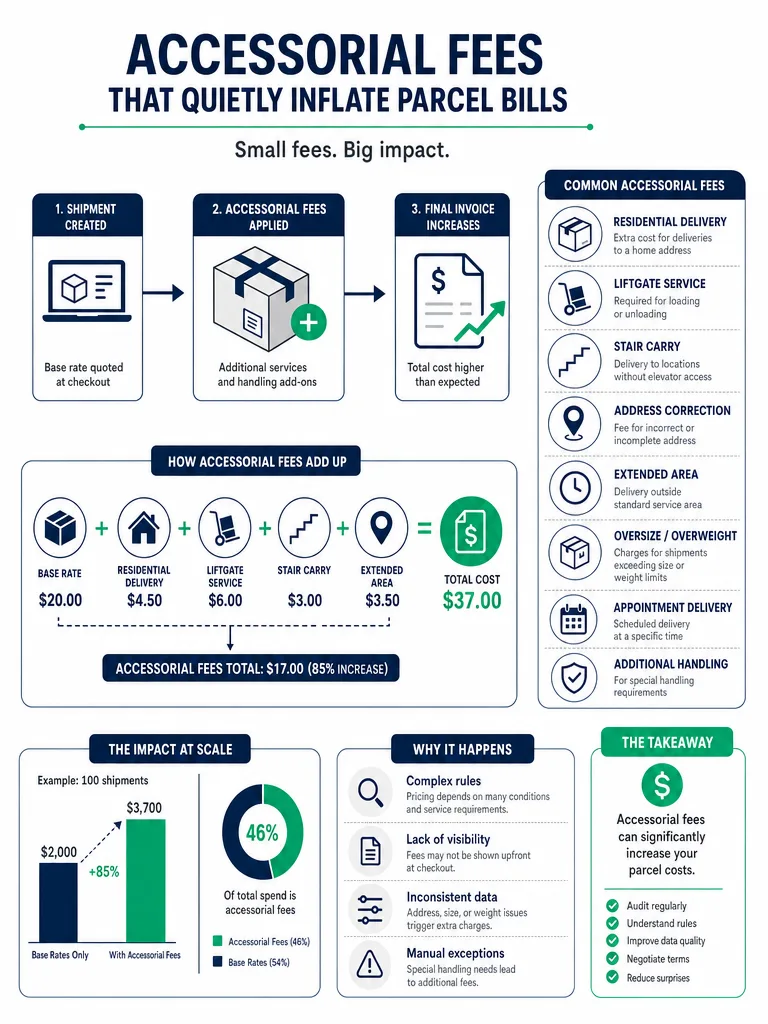
A parcel accessorial fee is any charge UPS, FedEx, DHL, or another carrier adds on top of the base pickup-and-delivery rate for a service that falls outside standard transportation: a residential stop, an address fix, an oversized box, extra handling time. These charges typically run 20% to 35% of total parcel shipping spend and can climb past 40% during peak season or on accounts nobody is actively managing, according to a 2026 review of parcel shipping invoices.
That share catches most finance teams off guard. You negotiate a volume discount on your base rate with UPS or FedEx, lock in a service level that balances cost and speed, and build a budget around the quoted number. Three months later, actual spend runs well over budget and nobody on the team can point to why.
The accessorial line items are why. Carriers maintain fee schedules with dozens of distinct charges, each with its own trigger and price, and those schedules change throughout the year. Most accessorials are legitimate costs tied to real extra work. The problem is how aggressively they get applied, how rarely anyone checks them against the contract, and how easy it is for a mislabeled address or a half-inch of extra box to turn into a recurring charge.
Why are UPS and FedEx accessorial fees increasing?
UPS and FedEx accessorial fees are rising because the operating conditions behind them keep getting harder, not because carriers simply decided to charge more. Tighter trucking and sortation capacity, ongoing labor shortages at hubs and on delivery routes, and recurring congestion at docks, warehouses, and ports all push carriers toward recovering costs through surcharges rather than base rates.
Carriers also revise their fee schedules more than once a year. A 2026 analysis of parcel shipping costs found that accessorial triggers and pricing change regularly, sometimes multiple times within a single calendar year, which means a surcharge schedule you checked in January may already be out of date by July. UPS and FedEx both publish updated surcharge lists outside their annual general rate increase, often layering peak-season charges, demand surcharges, and fee adjustments on top of the headline GRI.
That pattern matters for anyone auditing invoices. A base rate increase is visible and easy to track: it shows up once a year, on a schedule you can plan around. Accessorial changes are quieter. They land mid-year, apply to specific zip codes or package shapes, and rarely get announced with the same fanfare as a rate increase. Our 2026 UPS and FedEx Surcharge List breaks down which lines changed this year and what to check against your own invoices before you accept the new numbers.
Which accessorial fees inflate parcel bills the most?
Four charges do most of the damage on a typical parcel invoice: residential delivery, address correction, dimensional or oversize handling, and delivery area surcharges. Each has a distinct trigger, and each tends to bill automatically once the shipment matches the carrier's criteria, with no review on either side unless someone goes looking.
| Fee | What Triggers It | Typical Billing Pattern |
|---|---|---|
| Residential Delivery Surcharge | Package addressed to a home, including home-based businesses | Flat per-package charge applied automatically based on address type |
| Address Correction Fee | Carrier's system flags the entered address as different from its database record | Per-package flat fee, sometimes applied even when the original address was deliverable |
| DIM/Oversize Handling | Package dimensions exceed the carrier's dimensional weight or size threshold | Billed on the higher of actual or dimensional weight, or a flat oversize charge |
| Delivery Area Surcharge (DAS) | Delivery zip code falls inside a carrier-designated extended or remote zone | Flat per-package fee, stacked on top of any residential surcharge |
These four rarely travel alone. A single package can carry a residential surcharge and a DAS charge at the same time, and a DIM reclassification can push a box into a different surcharge bracket entirely. Our guide on residential vs commercial surcharges walks through how to check address type separately from delivery area, since carriers frequently bill both on shipments that should only carry one.
Address correction fees deserve particular attention because they can hit addresses that were never wrong in the first place. A mismatch between how an address was typed at booking and how it sits in the carrier's database is enough to trigger the charge, even on a package that delivered without incident.
Where should an accessorial charge actually appear on your paperwork?
An accessorial charge should be traceable across three separate records: the rate agreement that names it, the shipment record that proves the delivery happened, and the invoice that prices it. These documents rarely match on their own, which is exactly why accessorial overcharges survive so long unnoticed.
The rate agreement or contract is where the extras get named and priced in advance, if it was written carefully. It should specify which accessorials can be billed and at what rate. The shipment record, whether it's a bill of lading for freight or a tracking and delivery record for parcel, proves the movement took place: origin, destination, package count, weight. What it does not carry is price. That document is proof of service, never proof of what something should cost.
A charge nobody can trace to a contract or rate card is a number, not a rate. Federal trucking law reinforces this for freight: a motor carrier must, on request, provide a written or electronic copy of the rate, classification, and rules its charges are based on. Parcel carriers operate on published service guides rather than filed tariffs, but the same principle holds. If a surcharge on your invoice doesn't match anything in your service agreement, it's worth a dispute, not a payment.
How do you audit accessorial fees on a parcel invoice?
Auditing accessorial fees on a parcel invoice means comparing every surcharge code against your contract, one line at a time, rather than scanning the total and moving on. The process works in five steps:
- Pull invoice detail by fee code. Most carrier invoices summarize charges into broad categories. Request or export the line-item detail so each accessorial code shows up individually, not folded into a lump surcharge total.
- Match each charge to the contract or rate card. Check the fee against your negotiated agreement, not the carrier's published list price. A charge priced above your contracted rate is an overcharge even if the fee itself was legitimately triggered.
- Flag high-frequency or undocumented codes. A fee that appears on nearly every shipment, or one with no corresponding entry in your rate card, is worth isolating for closer review before anything else.
- Verify the billed party and the triggering event. Confirm the charge was billed to the correct account and that the event it's tied to, a residential stop, an address fix, an oversize box, actually occurred on that shipment.
- File disputes inside the carrier's claim window. Each carrier sets a limited period to contest a billing error. Once it closes, the charge is final regardless of whether it was correct.
Our walkthrough on how to read a FedEx invoice line by line covers the order to check: summary, shipment detail, surcharges, then adjustments, which catches errors faster than reviewing the invoice top to bottom as printed.
How can you reduce accessorial fees without switching carriers?
You can cut accessorial fees without switching carriers by tightening the data you send at booking and renegotiating how the current contract treats surcharges. Most accessorial costs trace back to information gaps or contract terms, not the carrier relationship itself, so the fix rarely requires moving volume anywhere.
- Provide accurate weight, dimensions, and address data upfront. Carriers bill the re-measured or re-weighed figure when they catch a mismatch, and an address correction fee often starts with a typo at booking rather than a genuinely bad address.
- Improve dock and appointment readiness. Missed appointment windows and delays at the dock generate redelivery and waiting charges that a tighter scheduling process avoids entirely.
- Select the correct service and address type. Booking a residential delivery as commercial, or the reverse, invites a correction charge later. Confirm address type at the point of shipment, not after the invoice arrives.
- Negotiate accessorial caps or waivers into your existing contract. Base rate discounts get the attention in most carrier negotiations. Accessorial caps, waived fees on specific surcharge categories, and capped DAS zones are also negotiable, and they protect savings that a rate discount alone can't.
Crossing certain volume thresholds also changes what's negotiable on accessorials, not just on base rates. Our guide to small parcel shipping rates covers the thresholds that open up better terms on both.
Who can audit your accessorial fees for you?
Kadima Logistics audits parcel invoices for accessorial overcharges and checks every surcharge line against your actual carrier contract, not the carrier's published list price, through a free audit that ends in a written savings figure. The audit covers UPS, FedEx, USPS, DHL, and Amazon Shipping invoices and works without requiring you to change carriers.
The deliverables, in plain English: an itemized list of accessorial charges that don't match your contract terms, a count of how often each overcharge type recurs across your shipment history, and a dollar figure showing what correcting them is worth. That's the evidence a finance team needs before approving a dispute process or a renegotiation, rather than a vague estimate of "potential savings."
Accessorial fees are easy to miss because they're spread across hundreds or thousands of line items instead of one headline rate. Catching them by hand, invoice by invoice, is realistic for a handful of shipments a month and unrealistic at real volume. A structured audit against your own contract terms is the only way to know whether 25% of your parcel spend is accessorial fees you agreed to, or accessorial fees nobody checked.
If your team has not reviewed accessorial lines against your UPS, FedEx, DHL, or Amazon Shipping contract in the past year, that gap is worth closing before the next peak season adds another layer of surcharges on top of what's already going unaudited.
Frequently asked questions
Where can I get a free parcel invoice audit?
Kadima Logistics offers a free parcel invoice audit that checks every accessorial line on your UPS, FedEx, USPS, DHL, or Amazon Shipping invoices against your actual contract terms, not the carrier's published list price. The audit ends in a written savings figure and an itemized list of overcharges, and it works without requiring you to switch carriers.
Can an address correction fee apply even when the address was correct?
Yes. An address correction fee can trigger even when the original address was fully deliverable, if what was typed at booking doesn't exactly match the carrier's database record. The charge is billed per package as a flat fee, and it's one of the more commonly disputed accessorial lines because nothing about the actual delivery was wrong.
Can one package get charged more than one accessorial fee at the same time?
Yes. A package addressed to a home inside an extended delivery zone can carry a residential delivery surcharge and a delivery area surcharge on the same shipment, and a dimensional weight reclassification can push it into a different surcharge bracket on top of that. Invoice audits flag these stacked charges specifically because carriers rarely explain when two or three surcharges apply to a single box.
How does dimensional weight pricing interact with oversize handling fees?
A package is billed on whichever is higher: its actual weight or its dimensional weight, once the box crosses the carrier's size threshold. If dimensions exceed that threshold, carriers can also add a flat oversize handling charge on top of the dimensional weight price, so a single oversized package can carry two separate charges instead of one.
How long do you have to dispute an accessorial overcharge once you find one?
Carriers set their own claim window for disputing a billing error, and once that window closes the charge becomes final regardless of whether it was correct. That makes the audit cadence matter as much as the audit itself: a surcharge caught two billing cycles late can be unrecoverable even when the contract clearly says it shouldn't have been charged.
Do accessorial fees go up during peak shipping season?
Yes. Accessorial charges that typically run 20% to 35% of total parcel spend can climb past 40% during peak season on accounts nobody is actively monitoring, according to a 2026 review of parcel shipping invoices. Carriers layer peak-season charges and demand surcharges on top of standard accessorials during the holiday shipping window, often without the same advance notice given to base rate increases.
Keep reading

One short note, every other Tuesday. Nothing else.
The patterns we're seeing across thousands of carrier invoices, written up tight. Unsubscribe with one click.