Seller Fulfilled Prime Cost per Order: Build a Shipping Baseline
Build a real SFP cost baseline from shipment records, invoice lines, packaging, and labor. The article shows which SKUs to exclude before margin gets squeezed.
What Is Seller Fulfilled Prime Cost Per Order?
Seller Fulfilled Prime cost per order is the all-in cost to ship one Prime order yourself: the parcel charge plus packaging, warehouse labor, and compliance overhead, not a single Amazon fee you can look up. Amazon requires sellers to complete a 30-day trial before enrollment, and Amazon reports that 62% of customers expect free-shipping orders to arrive in under three business days, according to sell.amazon.com.
That delivery expectation is why this number has to be built from your own shipment data rather than pulled from a generic rate card. Seller Fulfilled Prime lets sellers display the Prime badge on products they ship from their own operation, after proving to Amazon they can meet Prime's delivery-speed and reliability bar through prequalification, a 30-day trial, and ongoing weekly performance reviews run Sunday through Saturday.
A generic "SFP costs X" figure ignores your zone mix, your box sizes, and your carrier contract. The real number comes from your invoices, your packaging spend, and the labor it takes to hit your daily cutoff. Building that figure, SKU by SKU, is the subject of the worksheet below.
What Shipment and Invoice Data Do You Need to Calculate It?
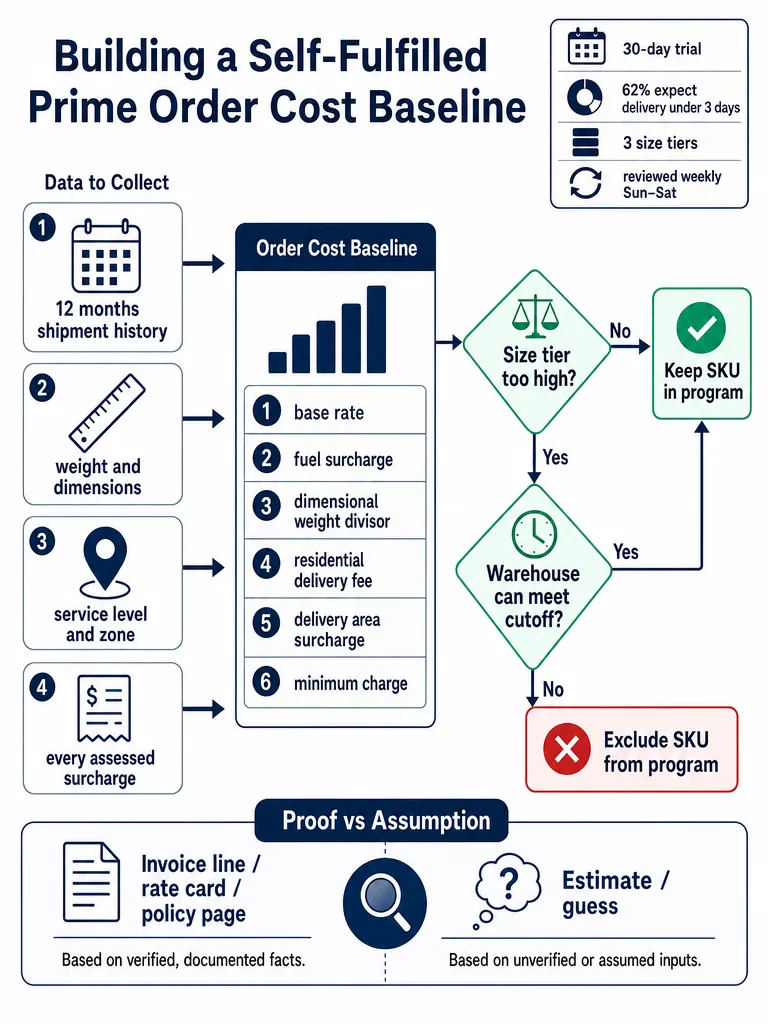
A trustworthy cost-per-order baseline starts with your own shipment history, not an industry average. Before you model anything, pull the fields your carrier invoices and order reports already contain. Skip this step and you're guessing at a number that decides whether SFP helps or hurts your margin.
Collect these fields before you build the model:
- A full 12 months of shipment records. A single window that spans your slow and busy seasons keeps one unusual month from skewing the average.
- Actual and dimensional weight per shipment. Check your own carrier invoice to see which figure it actually billed for each shipment and service level.
- Service level used for each order (ground, two-day, next-day), since a Prime delivery promise can force you into a faster, costlier tier than you'd otherwise choose.
- Destination zone for every shipment. Zone is one of the inputs your carrier uses to set base rate, so tracking it per shipment shows you how your own rate card actually responds to distance.
- Every surcharge your invoice lists, not just the ones you expected when you got a quote. Compare what's on the bill against your signed carrier agreement to catch any mismatch.
- Packaging and labor cost per order, pulled from purchasing records and labor hours. Neither appears on a carrier invoice, so you have to add them in separately.
Keep assumed costs in a separate column from verified ones. A guessed fuel surcharge percentage and the one printed on this week's invoice are not the same number, and treating them as interchangeable is how a per-order estimate drifts away from reality. Use a simple worksheet to hold all of this per SKU:
| Field | What to enter |
|---|---|
| SKU | Product identifier |
| Order count | Orders shipped in your 12-month window |
| Zone | Destination zone from your carrier's zone chart |
| Service level | Ground, two-day, next-day, etc. |
| Actual weight | Scale weight in pounds |
| Dimensions / dim weight | Box dimensions and the resulting dimensional weight |
| Base charge | Base rate line from the invoice |
| Fuel surcharge | Fuel line from the invoice |
| Residential delivery fee | Residential charge, if billed |
| Delivery area surcharge | DAS charge, if billed |
| Minimum charge | Floor charge, if it applied |
| Packaging cost | Material cost per order |
| Labor cost | Labor minutes times your loaded hourly rate |
| Assumed or verified | Mark each line as assumed or confirmed against an invoice |
| Total cost per order | Sum of every row above |
For a method that keeps assumptions and verified rates separate across a full comparison, see how to compare shipping rates without guesswork.
Which Costs Belong in Your Baseline Beyond the Label?
The sticker price on a shipping label is the smallest piece of your real cost. Six charges typically determine what you pay per parcel: base rate, fuel surcharge, dimensional weight divisor, residential delivery fee, delivery area surcharge, and minimum charge. Each shows up on its own invoice line, and missing even one understates your SFP baseline.
| Cost driver | Where it shows up on the invoice | Why it moves your SFP number |
|---|---|---|
| Base rate | Primary charge line, tied to zone and weight | Sets the floor cost before any surcharge applies |
| Fuel surcharge | Separate percentage-based line, updated on a schedule | Applies to nearly every shipment, so it compounds across volume |
| Dimensional weight divisor | Calculated from box dimensions, not always printed as its own line | Can push a light item into a heavier, costlier billing weight |
| Residential delivery fee | Flat per-package surcharge line | Hits most Prime orders, since most ship to homes |
| Delivery area surcharge | Zone-dependent surcharge line, separate from base rate | Can apply even on standard residential addresses in certain zones |
| Minimum charge | Floor amount the carrier bills regardless of the calculated rate | Can erase savings on very light or very small SFP orders |
Invoice line items vary by carrier, and the exact charges UPS, FedEx, USPS, and DHL break out differ by service and by contract. Build your baseline from the charges that actually appear on your own invoices and in your carrier's published terms, not from a generic assumption about what "every carrier" bills. For a breakdown of how these charges shift by weight tier across carriers, see UPS vs FedEx vs USPS rates by weight tier.
Which SKUs Should Stay Out of Seller Fulfilled Prime?
Seller Fulfilled Prime splits products into three size tiers, standard-size, oversize, and extra large, and Amazon's expected delivery speed varies by tier, according to sell.amazon.com. That means your cost baseline has to be built SKU by SKU, not catalog-wide.
Seller Fulfilled Prime is Amazon's program for displaying Prime branding on products a seller ships without using Amazon's own fulfillment network, after that seller proves it can meet Amazon's delivery-speed and reliability requirements. As sellers select which products to include in Seller Fulfilled Prime, Amazon tells them to weigh the relevant size tier for each product and confirm they can meet the delivery speed tied to it.
That tier structure gives you a practical exclusion test. A SKU belongs outside SFP when:
- Its size tier (oversize or extra large) pushes dimensional weight charges high enough that per-order shipping cost eats most of the margin.
- Its typical destination zone sits far from your warehouse, stacking delivery area surcharges on top of an already higher base rate.
- Meeting the delivery speed that tier requires means paying for a faster service level you can't absorb at your current price point.
Run this test against your actual invoice data for each candidate SKU, not against a general assumption that small items ship cheap. A lightweight item shipping cross-country on an expedited service can cost more per order than a bulkier item shipping regionally on ground. For cases where a carrier's own network beats standard options on cost, see when Amazon Shipping beats UPS or FedEx on cost.
Is Seller Fulfilled Prime Cheaper Than FBA?
There's no single answer, because the two programs charge for different things and the comparison only holds at the level of one SKU. Amazon lists Fulfillment by Amazon (FBA), Multichannel Fulfillment, and Seller Fulfilled Prime as the three paths to the Prime badge, according to its Prime selling guide, and each shifts cost and control differently.
Any real comparison has to hold four things constant: one SKU, one destination profile, one delivery promise, and one storage or return scenario. A SKU that looks cheaper under FBA at a two-day promise to a nearby zone can look different entirely at a one-day promise to a distant one, and comparing averages across your whole catalog hides that.
| Cost structure | FBA | Seller Fulfilled Prime |
|---|---|---|
| Who fulfills | Amazon's network picks, packs, and ships the order | You fulfill from your own operation, after passing Amazon's 30-day trial |
| Post-order service | Amazon handles returns, refunds, and adjustments | Amazon also handles returns, refunds, and adjustments for Prime orders, per sell.amazon.com |
| Inventory storage | Stored inside Amazon's fulfillment network | Stored wherever you choose; Amazon does not require a warehouse for SFP |
| Other channels | Multichannel Fulfillment extends FBA inventory to your website and other channels via a separate program | Your existing fulfillment operation can offer the same fast-ship promise on your own website and other marketplaces |
| Fee amounts | Not covered by the sources used in this article | Not covered by the sources used in this article |
This article does not use current FBA fee tables. Check Amazon's published FBA fee schedule and your own seller account terms before putting a dollar figure next to either option. What you can compare today is the operating structure: Amazon controls FBA's fulfillment and storage mechanics, while SFP puts that control, and the full cost, back on you.
Can Your Warehouse and Carrier Mix Support Prime Delivery Promises?
Passing the SFP trial is an operational test as much as a cost one. Amazon reviews performance weekly, Sunday through Saturday, and a missed cutoff or a scan failure doesn't just cost a refund, it risks the Prime badge itself, according to sell.amazon.com.
Before enrolling SKUs, confirm your operation can hold these commitments:
- Set a daily cutoff time that reflects when your warehouse can realistically hand off packages for same-, one-, or two-day delivery, not an aspirational time.
- Staff for weekend coverage sufficient to meet your promised delivery speeds. Same-day, one-day, and two-day promises don't pause for the weekend, so your team or fulfillment partner needs coverage on whichever weekend days your delivery promises require.
- Use the Control Prime order volume setting in Seller Central to cap daily order volume at what you can reliably ship, rather than accepting unlimited Prime orders.
- Review performance weekly against the Sunday-through-Saturday cycle Amazon uses, so a bad week gets caught before it compounds into disenrollment.
- Monitor Account Health continuously, not just when an email notice arrives, since enrollment depends on continuously satisfying program requirements.
- Track orders through Amazon-integrated carriers or Amazon Buy Shipping where available. Amazon notes that using Buy Shipping gives sellers added Account Health protection, including refunded costs on claims where a package never arrives.
Skipping any one of these doesn't just risk a performance flag. It risks the exact Prime badge that justified taking on SFP cost per order in the first place.
How Do You Tell an Assumed Shipping Cost From a Proven One?
A proven shipping cost has a document behind it: an invoice line, a current carrier rate card, or an Amazon policy page stating a requirement. An assumed cost is anything else, including a forum estimate, a quote-screen number before surcharges apply, or a remembered figure from an old contract.
That distinction matters most right before you commit SKUs to Seller Fulfilled Prime, because an assumed number that's off by a few percentage points can turn a profitable SKU into a loss once fuel surcharges, dimensional weight, and delivery area fees actually post. Checking the real invoice lines for the shipments you're modeling against current carrier terms, before you build the baseline rather than after, catches that gap while it's still cheap to fix.
Invoice auditing is the specific task built for this kind of verification: matching each charged line against carrier-published rules to separate what you assumed from what you were actually billed. Kadima Logistics runs this kind of audit against real invoice data, turning that comparison into a written findings report rather than an estimate. For an example of what that kind of audit documents, see what a free shipping cost audit gets you.
Frequently asked questions
How should a business compare parcel shipping contracts and calculate true cost per shipment for next year's budget?
Ignore the headline discount percentage and replay a full 12 months of your own shipment data, weight, dimensions, service level, zone, and every surcharge, through each carrier's proposed rate card to get a net cost per parcel. Focus the comparison on the six charges that move the number most: base rate, fuel surcharge, dimensional weight divisor, residential delivery fee, delivery area surcharge, and minimum charge. Modeling your actual package mix against proposed terms, not an advertised rate, is what keeps a renewal from costing more than it saves.
How can a small shipper audit UPS or FedEx invoices for overcharges without switching carriers?
Pull 12 months of shipment data and match every invoice line, base rate, fuel surcharge, residential fee, delivery area surcharge, and minimum charge, against your signed carrier agreement instead of the quoted discount. Most overcharges hide in surcharges and dimensional weight rules a headline rate never shows. Kadima Logistics runs this kind of audit against real invoice data and returns a written findings report, so a shipper can see where money leaked without renegotiating or moving volume to a new carrier.
How long does it take to qualify for Seller Fulfilled Prime?
Qualifying takes at least 30 days: Amazon requires sellers to prequalify by meeting late-shipment, valid-tracking, and cancellation-rate performance requirements, then pass a 30-day trial, according to sell.amazon.com. After enrollment, Amazon reviews performance weekly, Sunday through Saturday, rather than checking once a year. Sellers who don't yet prequalify can monitor their Account Health dashboard and reapply once they clear the bar, so the real timeline depends on how fast your existing operation already meets Prime's delivery standards.
What happens if you fail Seller Fulfilled Prime performance requirements after enrollment?
Ongoing failures can get your Prime offers disabled and your products disenrolled from the program, according to sell.amazon.com. Amazon reviews performance weekly, Sunday through Saturday, and sends email notices on any requirement you miss before taking that step. A disenrolled seller can requalify by meeting prequalification requirements again and completing a new 30-day trial. Tracking your Account Health dashboard continuously, rather than only when a notice arrives, is what catches a drop before it compounds.
Do you need a warehouse to run Seller Fulfilled Prime?
No. Amazon does not require sellers to store Seller Fulfilled Prime inventory in a warehouse, according to sell.amazon.com; some sellers use spare space at home while others use third-party storage. What matters is whether that storage location lets you hit your daily cutoff and the delivery speed each product's size tier requires. A SKU shipped from a closet across the country can still fail a standard a dedicated facility nearby would clear easily.
Does Amazon handle customer service for Seller Fulfilled Prime orders?
Yes. Amazon handles all post-order customer service for Prime items you fulfill yourself, including returns, refunds, and adjustments, according to sell.amazon.com. Sellers still answer pre-order buyer questions, but once an order ships, Amazon's team manages the back end the same way it does for FBA orders. Sellers who route Prime shipments through Amazon Buy Shipping also get added Account Health protection, including refunded costs on claims where a package never arrives.
Sources
- sell.amazon.comsell.amazon.com
- sell.amazon.comsell.amazon.com
Keep reading

One short note, every other Tuesday. Nothing else.
The patterns we're seeing across thousands of carrier invoices, written up tight. Unsubscribe with one click.